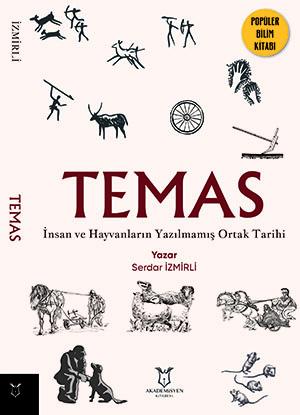
TEMAS: İnsan ve Hayvanların Yazılmamış Ortak Tarihi
Özet
Temas: İnsan ve Hayvanların Yazılmamış Ortak Tarihi, insanlık tarihinin seyrini değiştiren en önemli kırılma noktalarından biri olan evcilleştirme sürecini ve insan-hayvan etkileşimini merkezine alan ufuk açıcı bir çalışmadır. Yazar Serdar İzmirli, evcilleştirmeyi ateşin ve yazının bulunmasından daha büyük bir domino etkisi yaratan tarihi bir sıçrama olarak niteler. Kitap, yaklaşık 12 bin yıllık süreçte evcilleştirilen az sayıdaki türün, toplumların sosyolojik, askeri, ekonomik ve siyasal yapılarını nasıl şekillendirdiğini derinlemesine inceler. Köpeğin gönüllü dostluğuyla başlayan bu yolculuk; koyun, keçi ve sığırın evcilleştirilmesiyle insanlığa tarihte ilk kez kesintisiz ve sürdürülebilir bir gıda tedariki sağlamıştır. Sığır, insanlığın ilk büyük sermayesine dönüşürken; at, mesafeleri kısaltıp orduların gücünü belirleyerek küreselleşmenin ilk adımlarını atmıştır. Kitapta ayrıca medeniyetlerin gıdaya erişim mücadeleleri; Mayaların çöküşü, Vikinglerin adlardaki hayatta kalma serüvenleri ve salgın hastalıkların tarihe etkileri üzerinden ele alınır. Tarih boyunca Batı toplumlarının hayvanlara uyguladığı şiddet ile İslamiyet ve Osmanlı’daki şefkat odaklı vakıf kültürü arasındaki tezat çarpıcı şekilde ortaya konur. Eser, modern dünyada görünmez hale gelen bu kadim ortaklığa derin bir vefa ve teşekkür duruşudur.
Contact: The Unwritten Common History of Humans and Animals is an eye-opening study that focuses on the domestication process and human-animal interaction, which is one of the most critical turning points in the course of human history. The author, Serdar İzmirli, characterizes domestication as a historical leap that created a domino effect even greater than the discovery of fire and writing. The book profoundly examines how the few species domesticated over a period of approximately 12,000 years shaped the sociological, military, economic, and political structures of societies. This journey, which began with the voluntary companionship of dogs, provided humanity with uninterrupted and sustainable food supplies for the first time in history through the domestication of sheep, goats, and cattle. While cattle turned into humanity's first major capital, horses shortened distances and determined the power of armies, taking the first steps of globalization. The book also discusses societies' struggles for food security through the collapse of the Mayans, the survival sagas of Vikings on islands, and the historical impacts of pandemics. The contrast between the violence inflicted on animals by Western societies throughout history and the compassion-oriented foundation culture in Islam and the Ottoman Empire is strikingly presented. The work stands as a deep gesture of gratitude and loyalty to this ancient partnership that has become invisible in the modern world.
Referanslar
A Europan Public-Private Platform (2017). Why is Europan animal production important today? Facts and numbers. ATF Publications, Paris, France.
Abbaspour N, Hurrell R ve Kelishadi R (2014). Review on iron and its importance for human health. J Res Med Sci, 19(2): 164–174.
Acemoğlu D ve Robinson JA (2013). Why nations fail: the origins of power, prosperity and poverty (2012); Ulusların Düşüşü: Güç, zenginlik ve yoksulluğun kökenleri. Çeviren: Faruk Rasim Velioğlu., 1. Baskı: Doğan Kitap, İstanbul.
Adesogan AT, Havelaar AH, McKune SL, Eilittä M ve Dahl GE (2020). Animal source foods: Sustainability problem or malnutrition and sustainability solution? Perspective matters. Global Food Security, 25: https://doi.org/10.1016/j.gfs.2019.100325
Aksu L (2011). Dünya'da ve Türkiye'de nüfus analizleri. İstanbul Journal of Sociological Studies, 219-311.
Alexander D (2008). Saints and animals in the Middle Ages. The Boydell Press, UK.
Allen L (2014). Stagecoach travel, Shire publications, UK.
Allen RC (2012). The British industrial revolution in global perspective. 6th Printing, Cambridge Universtiy Press, UK.
Alonso HC ve Ruiz TF (2019). Economic life in late medieval and early modern Spain, 1085–1815, In book: Oxford Research Encyclopedia of Economics and Finance. DOI:10.1093/acrefore/9780190625979.013.481, Oxford University Press,UK.
Altuntaş H ve Şahin M (2006). Kur’an-ı Kerim meâli. 12. Baskı, Diyanet İşleri Başkanlığı, Baskı: Özgün Matbaacılık San. ve Tic. İşl., Ankara.
Andersson K ve Lehtola M (2011). Regulating the new equine industry in Finland. Wicked problems, governance models and gendered power structures. Sociologia Ruralis, 51 (4): 387-403.
Anderson WP, Reid CM, ve Jennings GL (1992). Pet ownership and risk factors for cardiovascular disease. Medical Journal of Australia, 157: 298 – 301.
Animal Medicines Australia (2016). Pet ownership in Australia 2016. Barton ACT, Australia.
Anon (2021). Agribusiness in Brazil: an overview. Syf:1-18, Erişim adresi: https://www.pwc.com.br/pt/publicacoes/setores-atividade/assets/agribusiness/2013/pwc-agribusiness-brazil-overview-13.pdf, Erişim tarihi: 06.03.2021.
Anon. (2020). Horses. Erişim adresi. https://www.nam.ac.uk/explore, Erişim tarihi: 15.11.2020.
Anon. (2020). Royal Dogs. Erişim adresi: https://www.royal.uk/royal-dogs, Erişim tarihi: 21.10.2020.
Appleby MC (2008). Long distance transport and welfare of farm animals. CABI, UK.
Arihara K ve Ohata M (2011). Functional meat product, In: Functional Foods (Second edition). Woodhead Publishing Series in Food Science, Technology and Nutrition, syf: 512-533.
Armutak A (2020). Atların yazılmamış tarihi Savaşlarda ölen ve yaralanan atlar. Syf: 145-147, Erişim adresi: https://www.zdergisi.istanbul/media/magazines/pdf/Atlar%C4%B1n_Yaz%C4%B1lmam%C4%B1s_tarihi_savaslarda_olen_ve_yaralanan_atlar.pdf, Erişim tarihi, 14.09.2020
Arnalds O (2019). Development of perverse environmental subsides for sheep production in Iceland. Agricultural Sciences, 10: 1135-1151.
Arneborg J, Heinemeier J, Lynnerup N, Nielsen H, Rud N ve Sveinbjörnsdóttir Á (1999). Change of diet of the Greenland Vikings determined from stable carbon ısotope analysis and 14C dating of their bones. Radiocarbon, 41(2): 157-168.
Arneborg J, Lynnerup N ve Heinemeier J (2012). "Human diet and subsistence patterns in Norse Greenland AD C.980—AD C. 1450: Archaeological interpretations. Journal of the North Atlantic, SP3: 119-133.
Aslan N (2010). Kurt motifinin Türk menşe efsanelerindeki anlamı üzerine. Millî Folklor, 22(87): 72-77.
Bacci ML (2017). A concise history of human population. 6.edition. Wiley Blackwell, UK.
Bachewe F, Minten B, Tadesse F ve Tafesse AS (2018). The evolving livestock sector in Ethiopia: Growth by heads, not by productivity. Working Paper 122, Ethiopian Development Research Institute.
Balasse M, Tresset A, Dobney K ve Ambrose SH (2005). The use of isotope ratios to test for seaweed eating in sheep. Journal of Zoology, 266(3): 283-291.
Baer GM (1991). The natural history of rabies, 2nd Edition, CRC Press, United States.
Barberis I, Bragazzi NL, Galluzzo L ve Martini M (2017). The history of tuberculosis: from the first historical records to the isolation of Koch's bacillus. J Prev Med Hyg. 58(1): E9–E12.
Bekman M. (1940). Veteriner Tarihi. Ankara Basım ve Cildevi, Ankara.
Bell AW, Charmley E, Hunter RA ve Archer JA (2011). The Australasian beef industries—Challenges and opportunities in the 21st century. Animal Frontiers, 1(2): 10-19.
Belury MA (2003) Conjugated linoleic acids in type 2 diabetes mellitus: implications and potential mechanisms, in Advances in Conjugated Linoleic Acid Research. (edit: Sebedio, J.L., Christie, W.W., and Adlof, R.O.), 2: 302–315, AOCS Press, Champaign.
Bernstein PL (2007). The human-cat relationship. Chapter 3., In: The Welfare of cats, Editor: I. Rochlitz, Springer. Syf: 47–89.
Black J (1990). Eighteenth century Europe, 1700-89. Macmillan Education, New York, United States of America.
Bonney R (1999). The rise of the fiscal State in Europe c.1200-1815. Oxford University Press, UK.
Borah M ve Halim RA (2014). Dynamics and performance of livestock and poultry sector in India: A temporal analysis. Journal of Academia and Industrial Research, 3 (1): 1-9.
Both L, White J, Mandal S ve Efstratiou A (2014). Access to diphtheria antitoxin for therapy and diagnostics. Euro Surveill. 19(24): pii=20830. https://doi.org/10.2807/1560-7917.ES2014.19.24.20830
Boyd J (2010). Horse power: the Japanese army, Mongolia and the horse 1927–43. Japan Forum, 22(1-2): 23-42.
Byock J, Walker P, Erlandson J, Holck P, Zori D, Guđmundsson M ve Tveskov M (2005). A Viking-age valley in Iceland: The mosfell archaeological Project. Medieval Archaeology, 49(1): 195-218.
Brade W (2013). German riding horse breeding- current state of play and economic impact. Berichte Uber Landwirtschaft, 91(1); Record Number 20133389709.
Bradford GE (1999). Contributions of animal agriculture to meeting global human food demand. Livestock Production Science, 59 (2–3): 95-112.
Breiding DH. (2010). “Horse armor in Europe.” In heilbrunn timeline of art history. New York: The Metropolitan Museum of Art, 2000–. http://www.metmuseum.org/toah/hd/hors/hd_hors.htm (March 2010)
British Nutrition Foundation (2021). Healthy living. Erişim adresi: https://www.nutrition.org.uk/healthyliving/basics/exploring-nutrients.html, Erişim tarihi: 08.03.2021.
Brown J (1989). Horses in Shropshire mines, British mining. no:39, syf: 78-88, Published by: The northern mine research society, Sheffield, UK.
Brown JL (1980). Earthworks and ındustrial archeology. IA. The Journal of the Society for Industrial Archeology, 6(1): 1-8.
Cáceres SB (2011). The long road to eradicate rinderpest. Letter to Editor, Veterinary Research Forum, 2(3): 145- 146.
Calderón EDA, Merino AL, Sriranganathan N, Boyle SM ve Rodríguez AC (2013). A history of the development of brucella vaccines. BioMed Research International, Article ID 743509, Volume 2013, 8 pages, https://doi.org/10.1155/2013/743509
Caner C, Kaynak K ve Güneşer O (2005). Besin piramidleri. Akademik Gıda, 3(3): 21-25.
Carnovale F ve Phillips CJC (2020). The effects of heat stress on sheep welfare during live export voyages from Australia to the Middle East. Animals, 10:694; doi:10.3390/ani10040694.
Casolani CE (2018). Horsemanship. Publisher: Encyclopædia Britannica.
Champion S (2012). The history of wool promotion. Wool Marketing & Clip Preparation, The Australian Wool Education Trust.
Chemnitz C ve Becheva S (2014). Meat atlas: Facts and figures about the animals we eat. Published by: Heinrich Böll Foundation, Germany.
Chin SF, Liu W, Storkson JM, Ha YL ve Pariza MW (1992). Dietary sources of conjugated dienoic isomers of linoleic acid, a newly recognized class of anticarcinogens. Journal of Food Composition and Analysis, 5: 185-197.
Choudhury S ve Headey DD (2018). Household dairy production and child growth: Evidence from Bangladesh. Economics and Human Biology, 30: 150-161.
Coale AJ (1974). The History of the human population. Scientific American, 231(3): 40-51.
Collins BJ (2002). A history of the animal world in the ancient Near East. Publisher: Brill Academic, Netherlands.
Colton KE (1939). Stagecoach travel in Iowa. Annals of IOWA, 22(3): 175-200.
Como M (2007). Horses, dragons, and disease in Nara Japan. Japanese Journal of Religious Studies, 34(2): 393-415.
Conroy AB ve Teweldmehidin MY (2010). The economic importance of draught oxen on small farms in Namibia’s eastern Caprivi Region. African Journal of Agricultural Research, 5(9): 928-934.
Copland JW (1985). Draught animal power for production. Proceedings of an International Workshop Held at James Cook University, Townsville, Qld, Australia.
Cottle D ve Khan L (2014). Beef cattle production and trade. CSIRO Publishing, Collingwood VIC, Australia.
Çağrı ÇS, Arıcan MK ve Yaşar A (2015). Hadislerde hayvanları koruma ve gönenci (refahı) üzerine bir değerlendirme. Erciyes Üniversitesi Veteriner Fakültesi Dergisi, 12(2): 115-121.
Çalışkan N, Aydın M ve Aslanderen M (2014). Empati ve hayvanlarla iletişim. Ahi Evran Üniversitesi Sosyal Bilimler Enstitüsü Dergisi, 1(1): 29-42.
Çolak M (2004). XX. yüzyıl başlarında İstanbul'da trafik ve tramvay. İstanbul Üniversitesi Yakın Dönem Türkiye Araştırmaları Dergisi, 5: 75-87.
Deane PM (1979). The first industrial revolution. Second Edition, Cambridge University Press, UK.
Delgado C, Rosegrant M, Steinfeld H, Ehui S ve Courbois C (2001). Livestock to 2020: the next food revolution. Outlook on Agriculture, 30(1): 27–29.
Dembicki D ve Anderson, J. (1996). Pet ownership may be a factor in improved health of the elderly. Journal of Nutrition for the Elderly, 15: 15 – 31.
DeMello M (2012). Animals and society: An introduction to human-animal studies. Cloumbia University Press, New York.
DeWitte S ve Slavin P (2013). Between famine and death: England on the eve of the black death—evidence from paleoepidemiology and manorial accounts, Journal of Interdisciplinary History, 44(1): 37-60.
Dewitt M (2014). Amazon animal series. Part 5: The Jaguar, Erişim adresi: https://blog.pachamama.org/amazon-animal-series-part-5-the-jaguar, Erişim tarihi: 21.10.2020.
Diamond J (2003). Tüfek, mikrop ve çelik. İngilizce ilk baskı: 1997, Çeviren: Ülker İnce, 5. Basım, Tübitak Popüler Bilim Kitapları 174, Ankara.
Diamond J (2019). Çöküş: Toplumlar başarısızlığı ya da başarıyı nasıl seçerler. İngilizce ilk baskı: 2005, Çeviren: Barış Baysal, 1. Baskı, Pegasus Yayınları, İstanbul.
Diamond J (2019). Yükseliş: Krizdeki uluslar için dönüm noktaları. İngilizce ilk baskı: 2019, Çeviren: Barış Baysal, 1. Baskı, Pegasus Yayınları, İstanbul.
DiNardo RL (2008). Mechanized juggernaut or military anachronism? Horses and the German army of WWII. Published by Stackpole Books, Mechanicsburg, PA, USA.
Ding MJ, Jie F, Parton KA ve Matanda MJ (2008). Relationships between quality of information sharing and supply chain food quality in the Australian beef processing industry. The International Journal of Logistics Management, 25(1): 85-108.
Dror DK ve Allen LH (2011). The importance of milk and other animal-source foods for children in low-income countries. Food and Nutrition Bulletin, 32(3): 227-243.
Dugmore AJ, McGovern TH, Vésteinsson O, Arneborg J, Streeter R ve Keller C (2012). Cultural adaptation, compounding vulnerabilities and conjunctures in Norse Greenland. PNAS, 109 (10): 3658–3663.
Erk N (1966). Veteriner Tarihi. Ankara Üniversitesi Basımevi, Ankara.
Eurostat (2021). Agricultural production- livestock and meat. Erişim adresi: https://ec.europa.eu/eurostat/statisticsexplained/index.php?title=Agricultural_production_-_livestock_and_meat&oldid=470510, Erişim tarihi: 17.01.2021.
Fairly J (2015). Horses of the great war: The story in art. Pen & Sword Military, England.
FAO (2013) World cattle inventory. (FAO): Highlights.
FAO (2015). Production / Live Animals. http://faostat3.fao.org/browse/Q/QA/E, Erişim Tarihi. 05.05.2015.
FAO (2018). World livestock: Transforming the livestock sector through the sustainable development goals. Rome. 222 pp. Licence: CC BY-NC-SA 3.0 IGO.
FAO (2019). Dairy Market Review. March, Rome.
FAO (2019). Livestock production. http://www.fao.org/3/y4252e/y4252e07.htm#TopOfPage, Erişim Tarihi: 23/05/2019.
FAO (2019). Statistics. http://www.fao.org/statistics/en/, Erişim Tarihi: 21/05/2019.
FAO (2020). Food and agriculture data. İnternet adresi; http://www.fao.org/faostat/en/#home, Erişim tarihi; 11.09.2020
FAO (2020) Livestock commodities. Erişim adresi: http://www.fao.org/3/y4252e/y4252e05b.htm, Erişim tarihi: 14.01.2021.
FAO (2021). Main topics. Erişim adresi http://www.fao.org/themes/en, Erişim tarihi: 17.01.2021.
Fink-Kessler A (2015). A study of the German milk market following the abolition of quotas. Working Paper, syf: 1-27.
Francis J (1851). A history of the English railway: Its social relations & revelations 1820-1845. David&Charles (Publishers) Ltd., UK.
Franco NH (2013). Animal experiments in biomedical research: A Historical perspective. Animals, 3: 238-273.
Franklin A (1999). Animals and modern cultures: a sociology of human-animal relations in modernity. Sage Publications Ltd., London, Great Britain.
Frassinetti S, Bronzetti GL, Caltavuturo L, Cini M ve Croce CD (2006). The role of zinc in life: A review, Journal of Environmental Pathology, Toxicology and Oncology, 26(3): 597-610.
Few M ve Tortorici Z (2013). Centering animals in Latin American history. Duke University Press, United States of America.
Fite GC (1950). Recent progress in the mechanization of cotton production in the United States. Agricultural History, 24(1): 19-28.
Fite GC (1984). Cotton fields no more: Southern agriculture, 1865-1980. The University Press Of Kentucky, United States of America.
Fitzhugh WW (2000). Vikings: The north Atlantic Saga. AnthroNotes, 22(1): 1-9.
Foster SF ve Overall KL (2014). The welfare of Australian livestock transported by sea. The Veterinary Journal, 200: 205–209.
Fussell P (197). The great war and modern memory. Sterling Publishing Co., Inc., New York, USA.
Ganzel B (2020). Horses finally lose their Jobs. Erişim adresi: https://livinghistoryfarm.org/farminginthe40s/machines_13.html, Erişim tarihi: 03.02.2021.
GDP (current US$). World Development Indicators. World Bank. Retrieved 2 July 2020.
Gill M (2012). The goods and bads of livestock for development. Special issue on Livestock in Development, 17, Article 1:4-6.
Gordon RJ (2016). The rise and fall of American growth: The U.S. standard of living since the civil war. Princeton University Press, USA.
Görgülü M (2004). Sindirim sistemi ve besleme, Çukurova Üniversitesi, Adana.
Grasgruber P, Sebera M, Hrazdira E, Cacek J ve Kalina T (2016). Major correlates of male height: A study of 105 countries. Economics and Human Biology, 21: 172-195.
Greene AN (2008). Horses at work: Harnessing power in industrial America, Harvard University Press. United States of America.
Gupta AK (2004). Origin of agriculture and domestication of plants and animals linked to early Holocene climate amelioration. Current Science, 87(1): 54-59.
Hall SJG (1975). Some recent observations on Orkney Sheep. Mammal Review, 5(2): 59-64.
Hall SJG (2005). The horse in human society. In: The domestic horse: The origins, development and management of its behaviour. Editors: Mills DS and McDonnell SM., Cambrdige University Press, UK.
Hannah Ritchie ve Max Roser (2013). Land Use. Published online at OurWorldInData.org. Retrieved from: 'https://ourworldindata.org/land-use' [Online Resource].
Hannah Ritchie (2017). "Meat and Dairy Production". Published online at OurWorldInData.org. Retrieved from: 'https://ourworldindata.org/meat-production' [Online Resource] (This article was first published in August 2017; last revision in November 2019.).
Hannon G, Wastegård S, Bradshaw E ve Bradshaw R (2001). Human impact and landscape degradation on the Faroe Islands. Biology and Environment: Proceedings of the Royal Irish Academy, 101B (1/2): 129-139.
Harman C (2019). Halkların dünya tarihi: Taş devrinden yeni binyıla. Çeviren: Uygur Kocabaşoğlu, Yedinci Basım, Yordam Kitap, İstanbul.
Headey, B. (1998). Health benefits and health cost savings due to pets: Preliminary estimates from an Australian national survey. Social Indicators Research, 47: 233 – 243.
Helfen O.M. ve Helfen O (1973). The World of the Huns: Studies in their history and culture. University of California University Press, United States of America.
Herrero M, Grace D, Njuki J, Johnson N, Enahoro D, Silvestri S ve Rufino MC (2013). The roles of livestock in developing countries. Animal, 7: Supplement 1: 3-18.
Hill MW (1961). Some aspects of the timber industry in Canadian--American relations. George Fox College Journal, 7(1): 1-23.
Hribal J (2003). Animals are part of the working class: A challenge to labor history. Labor History 44(4): 435-53.
Hribal JC (2007). Animals, agency, and class: Writing the history of animals from below. Human Ecology Review, 14(1): 101-112.
Hume JB ve Thacker JNR (2000). Wells, Fargo & Co. stagecoach and train robberies, 1870-1884: The Corporate report of 1885 with additional facts about the crimes and their perpetrators. Edited and Expanded by Wilson RM, McFarland & Company, Inc., Publishers, North Carolina, USA.
Islam MM, Anjum S, Modi RJ ve Wadhwani KN (2016). Scenario of livestock and poultry in India and their contribution to national economy. International Journal of Science, Environment and Technology, 5(3):956 – 965.
Iverson P (1994). When Indians became cowboys: Native peoples and cattle ranching in the American West. University of Okolhama Press, USA.
Izmirli S ve Yasar A. (2011). Determining scientific performance of some of laboratory animal journals in veterinary science with the ethical approach. Kafkas Univ Vet Fak Derg, 17(1):83-87.
Kaegi WE (1964). The contribution of archery to the Turkish conquest of Anatolia. Speculum, 39(1): 96-108.
Kalof L (2007). Looking at animal in the human history. Published by Reaktion Books Ltd., London, UK.
Kaplan SL (1982). The famine plot persuasion in eighteenth-century France. Transactions of the American Philosophical Society, 72(3): 1-79.
Karaman MA (2018). Fransız İhtilali’nin Osmanlı İmparatorluğu’na etkileri. SDÜ Fen-Edebiyat Fakültesi Sosyal Bilimler Dergisi, 44: 62-79.
Kaszynski W (2000). The American highway: the history and culture of roads in the United States. McFarland & Company, Inc., Publishers, North Caroline, United States of America.
Katcher AH, Friedmann E, Beck AM ve Lynch JJ (1983). Talking, looking, and blood pressure: physiological consequences of interaction with the living environment. In a. H. Katcher & a. M. Beck (Eds.), New perspectives on our lives with companion animals (pp. 351 – 359). University of Pennsylvania Press. Philadelphia, USA.
Kirchubel R (2003). Operation Barbarossa 1941 (1): Army group South. Osprey Publishing, UK.
Kleinman LC (1992). To end an epidemic — lessons from the history of diphtheria. N Engl J Med; 326:773-777, DOI: 10.1056/NEJM199203123261118
Klopsteg PE (2019). Türk okçuluğu, İngilizce ismi: Turkish archery and the compasite bow. Çevirmen: Ömer Seyfi Saruhanoğlu ve Uğur Kâşif Boyacı, Erdem Yayınları, İstanbul.
Kokdaş İ (2007). Celeps, buthchers, and the sheep. The worlds of meat in İstanbul in the sixteenth and seventeenth centuries. Sabancı University.
Kooi BW ve Bergman CA (1997). An approach to the study of ancient archery using mathematical modelling. Antiquity, 71:271: 124–134.
Kotilainen Juha ve Rytteri Teijo (2011). Transformation of forest policy regimes in Finland since the 19th century. Journal of Historical Geography, 37(4): 429-439.
Kritchevsky, D. (2003) Conjugated linoleic acids in experimental atherosclerosis, in advances in conjugated linoleic acid research. (edit: Sebedio, J.L., Christie, W.W., and Adlof, R.O.), 2: 292–301, AOCS Press, Champaign.
Kure M (2002). Samurai: An illustrated history. Tuttle Publishing, Boston, USA.
Jacobsen NK (1987). Studies on soils and potential for soil erosion in the sheep farming area of South Greenland. Arctic and Alpine Research, 19(4): 498-507.
Jie F ve Parton KA (2016). Supply chain performance flexibility in the Australian beef industry. International Journal of Logistics Research and Applications, 19(4): 300-317.
Joanna D, Darcy G ve Christabelle S (2017). Animal metropolis: Histories of human-animal relations in Urban Canada. University of Calgary Press, Canada.
Joel A. Tarr ve Clay Mcshane (2008) The horse as an urban technology, Journal of Urban Technology, 15(1): 5-17.
Johnson B (2020). History of the wool trade. Erişim adresi: https://www.historic-uk.com/HistoryUK/HistoryofEngland/Wool-Trade/, Erişim tarihi: 19.10.2020.
Lamberg JA, Ojala J, Peltoniemi M ve Särkkä T (2012). The evolution of global paper industry 1800¬–2050: A comparative analysis. Springer, New York.
Langer WL (1964). The Black Death, Scientific American. 210(2): 114-121.
Large Scale Agriculture (2018) Top Australia’s biggest catte stations. Erişim adresi: https://www.largescaleagriculture.com/home/news-details/top-10-australias-biggest-cattle-stations/, Erişim tarihi: 23.06.2021
Lawrence PR ve Pearson RA (2002). Use of draught animal power on small mixed farms in Asia, Agricultural Systems, 71(1-2): 99-110.
Leinonen RM (2013). Finnish narratives of the horse in World War II, In: Animals and war: Studies of Europe and North America. Editor: Hediger R, Publisher: Brill.
Lhoste P, Havard M, Vall E ve Smith AJ (2013). Draught animals. Londres: Macmillan Education, CTA, syf:160.
Lombard M, Pastoret PP ve Moulin AM (2007). A brief history of vaccines and vaccination. Rev. sci. tech. Off. int. Epiz., 26(1): 29-48.
Larson G ve Burger J (2013). A population genetics view of animal domestication. Trends in Genetics, 29(4): 197-205.
Lloyd TH (2005). The Britain wool trade in the Middle Ages. Cambridge University Press, UK.
Lynnerup N ve Nørby S (2004). The Greenland Norse: bones, graves, computers, and DNA. Polar Record, 40(213): 107–111.
Malthus TR (2018). Nüfus ilkesi üzerine bir deneme. Çeviren: Sevil Zengin, Gece Kitaplığı, Ankara.
Maluf NSR (1954). History of blood transfusion. Journal of the History of Medicine and Allied Science, 9 (1): 59-107.
Marriot E (2020). Bir nefeste dünya tarihi, Maya Kitap, İstanbul.
McClure SB (2013). Domesticated animals and biodiversity: Early agriculture at the gates of Europe and long-term ecological consequences. Anthropocene, 4: 57-68.
McMichael A, Powles,JW, Butler CD ve Uauy R (2007). Energy and health 5: Food, livestock production, energy, climate change, and health. Lancet, 370: 1253–63.
Meat & Livestock Australia (2020). Cattle numbers – as at June 2019. Natural Resource Management Region, Published June 2020 by Meat & Livestock Australia Limited, NSW, Australia.
Moore DW (2015). The other British Isles: A History of Shetland, Orkney, the Hebrides, Isle of Man, Anglesey, Scilly, Isle of Wight and the Channel Islands. McFarland & Company, Inc., Publishers, United States of America.
Morris E (2007). From horse power to horsepower. Access; 30: 2-9.
Morrow JH (1993). The great war in the Air: Military aviation from 1909 to 1921. The University of Alabama Press, USA.
Mottet A, De Haan C, Falcucci A, Tempio G, Opio C ve Gerber P (2017). Livestock: On our plates or eating at our table? A new analysis of the feed/food debate. Global Food Security, 14:1-8.
Moyer K (2021). History of horse power on the Farm, Erişim adresi: https://blog.aghires.com/history-of-horses/, Erişim Tarihi: 03.03.2021.
Murphy SP ve Allen LH (2003). Nutritional importance of animal source foods. The Journal of Nutrition, 133(11): 3932S–3935S.
Musoke MS (1981). Mechanizing cotton production in the American South: The tractor, 1915-1960. Explorations in Economic History, 18(4): 347- 375.
NCC Broiler Council (2020). Industry history. Erişim adresi: https://www.nationalchickencouncil.org/industry/history/, Erişim tarihi: 19.12.2020.
Negassa A, Rashid S, Gebremedhin B ve Kennedy A (2012). Livestock production and maeketing, In: Food and agriculture in Ethiopia: Progress and Policy Challenges. Editors: Dorosh P and Rashid S, University of Pennsylvania University, United States of America.
New Zealand History (2020). New Zealand's first sheep released. Erişim adresi: https://nzhistory.govt.nz/first-sheep-released-in-new-zealand, Erişim tarihi: 17.10.2020.
Norwalt MRS (2009). The human–animal bond with laboratory animals. Lab Animal, 38:132–136.
Olson KC (2001). Development of the national cattle trade. Rangelands, 23(5): 3-6.
Öztürk M (2019). Osmanlı Devleti'nde hayvancılığın iktisadi boyutu. Bellek Uluslararası Tarih ve Kültür Araştırmaları Dergisi, 1(1): 28-44.
Outram AK, Stear NA, Bendrey R, Olsen S, Kasparov A, Zaibert V, Thorpe N ve Evershed RP (2009). The earliest horse harnessing and milking. Science: 323 (5919):1332-1335.
Pariza MW, Park Y.ve Cook ME (2001) The biologically active ısomers of conjugated linoleic acid. Progr. Lipid Res. 40: 283–298.
Pawlak, R., Lester, S. ve Babatunde, T (2014). The prevalence of cobalamin deficiency among vegetarians assessed by serum vitamin B12: a review of literatüre. Eur J Clin Nutr, 68: 541–548.
Parks M (2017). The history of public bus transportation. Erişim adresi: https://dharristours.com/site/blog/history-of-public-bus-transportation, Erişim tarihi: 4.11.2020.
Phoofolo P (2003). Face to face with famine: The BaSotho and the rinderpest, 1897-1899. Journal of Southern African Studies, 29(2): 503-527.
Pond WG ve Bell AW (2005). Encyclopedia of animal science. Markel Dekker, New York, USA.
Phaniraja KL ve Panchasara HH (2009). Indian draught animals power. Veterinary World, 2(10): 404-407.
Price E.O. (2002). Animal domestication and behavior. Cabi, UK.
Raento P (2016). A geopolitics of the horse in Finland. Geopolitics, 21(4): 945-968.
Räsänen T ve Syrjämaa T (2017). Shared lives of humans and animals: Animal agency in the Global North. Routledge, London and New York.
Rasmussen R0 (2021). Greenland. Publisher: Encyclopædia Britannica. Erişim adresi: https://britannica.com./place/Greenland. Erişim Tarihi: 14.02.2021.
Reeds PJ (2000). Dispensable and indispensable amino acids for humans. The Journal of Nutrition, 130(7): 1835S–1840S.
Renger J (2007). Economy of ancient Mesopotamia, chapter, In: The Babylonian World. Routledge, London, UK.
Riedel S (2017). Edward Jenner and the history of smallpox and vaccination. Baylor University Medical Center Proceedings, 18(1): 21-25.
Riedener U ve Simon J (2008). Technical-scientific information. 5th IDF Symposium on Cheese Ripening. 9-13 March 2008, Bern, Switzerland.
Ryder ML (1964). The history of sheep breeds in Britain. The Agricultural History Review, 12(2): 65-82.
Ritvo H (1994). Animals and human society: Changing perspective. Editors: Manning A ve Serpell J; In: Chapter 6: Animals in Nineteenth-century Britain: Complicated Attitudes and Competing Categorie. Routledge London, UK.
Roberts CA, McBride EA, Rosenvinge HP, Stevenage SV ve Bradshaw JWS (1996). The pleasure of a pet: The effect of pet ownership and social support on loneliness and depression in a population of elderly people living in their own homes. In J. Nicholson & A. Podberscek (Eds.), Further issues in research in companion animal studies (pp. 64). Callander: The Society for Companion Animal Studies.
Robertson SA. (2008). A review of feral cat control. Journal of Feline Medicine and Surgery. 10(4): 366-375.
Quinn MS (2003). Corpulent cattle and milk machines: Nature, art and the ideal type. Society & Animals, 1(2): 145-157.
Salisbury J (2011). The beast within animals in the Middle Ages. 2nd edition, Routledge, London and New York.
Sandler MW (2003). Galloping Across the U.S.A.: Horses in American life. Oxford University Press, UK.
Sarah L ve Crowley (2014) Camels out of place and time: The dromedary (Camelusdromedarius) in Australia. Anthrozoös, 27:(2): 191-203.
Schoof N, Luick R, Jürgens K ve Jones G (2020). Dairies in Germany: Key factors for grassland conservation? Sustainability, 12:4139; doi:10.3390/su12104139.
Seaton PA (2016). Local history and war memories in Hokkaido. Routledge, UK.
Serpell JA (2014). Domestication and history of cat, In: The Domestic Cat: The Biology of its Behaviour. Edited by: Turner DC and Bateson P, Third edition, Cambrdige University Press, UK.
Sharer RJ ve Traxler LP (2006). The ancient Maya. Stanford University Press, California, United States of America.
Siddiq AB ve Habib A (2017). Antropoloji’de ortaya çıkan çok-disiplinli güçlü bir alt bilim: Antrozooloji. Artuklu İnsan ve Toplum Bilim Dergisi, 2(1): 22-35.
Siegel, J. M. (1990). Stressful life events and use of physician services among the elderly: The moderating role of pet ownership. Journal of Personality and Social Psychology, 58: 1081 – 1086.
Silveira TS, Fabris DR, Neto AN, Jùnior CAG, Cardoso BF ve Shikida PFA (2015). Input-Output Analysis for agricultural and livestock sector in the Brazilian economy. Rivista di Economia Agraria, Anno LXX, n. 1: 33-54.
Simpson IA, GuDmundsson G, Thomson AM ve Cluett J (2004). Assesing the role of winter grazzing in historic land degradation, My´vatnssveit, Northeast Iceland. Geoarchaeology: An International Journal, 19(5): 471-502.
Simpson M (2015). Making a nation: Afghans and their camels for Australian inland transport. Museum ofApplied Arts & Sciences, Australia.
Singer P (2002). Animal liberation, Türkçe çeviri: Hayrullah Doğan, Hayvan Özgürleşmesi. Ayrıntı Yayınları, İstanbul.
Singleton J (1993). Britain's military use of horses 1914-1918. Past & Present, syf: 178-203, Oxford University Press, UK.
Smil V (2002). Eating meat. Evolution, patterns and consequences. Population and development review., 28(4): 599-639.
Smith A (2017). The wealth of nations (1776). Ulusların Zenginliği, Çeviren: Yunus A ve Bakırcı M, Alan Yayıncılık, İstanbul.
Spencer S, Decuypere E, Aerts S and Tavernıer JD (2006). History and ethics of keeping pets: comparison with farm animals. Journal of Agricultural and Environmental Ethics, 19:17–25.
Spinage CA (2003). Cattle plague: A history. Kluwer Academic/Plenum Publishers, New York.
Squicciarini M P ve Swinnen J (2016). The economics of chocolate. Oxford University Press, UK.
Stahel D (2009). Operation Barbarossa and Germany's defeat in the east. Cambridge University Press, Cambridge, UK.
Standage T (2020). İnsanlığın yeme tarihi. 4. Baskı, Maya Kitap, İstanbul.
State library (2020). Australian agricultural and rural life: Riding on the sheep's back. Erişim adresi: https://www.sl.nsw.gov.au/stories/australian-agricultural-and-rural-life/australian-wool, Erişim tarihi: 14.10.2020.
Stevenson RD ve Wassersug RJ (1993). Horsepower from a horse. Scientific Correspondence, Nature, 364: 195.
Sunseri T (2018). The African rinderpest panzootic, 1888–1897. Retrieved 10 Dec. 2020, Oxford Research Encyclopedia of African History.
Ucko PJ ve Dimbleby GW (2017). The domecticatiton and exploitation of plants and animals. Routledge, Taylor&Francis Group, USA.
Urwin GJW (2020). Battle of the Little Bighorn. Publisher: Encyclopædia Britannica.
U.S. Geological Survey (2019). Mineral commodity summaries 2019: U.S. Geological Survey. 200 p., https://doi.org/10.3133/70202434
U.S. Department Of Agriculture (2021). Topics. Erişim Tarihi: 17.01.2021. Erişim adresi: https://www.usda.gov/topics.
U.S. Department of Health and Human Services and U.S. Department of Agriculture. (2015). 2015–2020 Dietary Guidelines for Americans. 8th Edition. December 2015. Available at http://health.gov/dietaryguidelines/2015/guidelines/.
Tan L (2017). Western Australia. Redback Publishing, NSW, Australia.
Tanyu H (1984). Totem, totemizm ve tabu üzerine yeni araştırmalar. A.Ü. İlahiyat Fakültesi Dergisi, 26: 155-172.
Tarr JA (1999). A note on the horse as an urban power source. Journal of Urban History, 25(3): 434-448.
Tezer H (2016). Difteri, tetanoz & boğmaca aşıları. Klinik Tıp Pediatri Dergisi, 8 (4): 27-32.
The Editors of Encyclopaedia Britannica (2017). Appian way. Publisher: Encyclopædia Britannica.
The Editors of Encyclopaedia Britannica (2019). Stagecoach. Publisher: Encyclopædia Britannica.
The Editors of Encyclopaedia Britannica (2020). Jethro Tull. Publisher: Encyclopædia Britannica.
The Editors of Encyclopaedia Britannica (2021). Thomas Newcomen. Publisher: Encyclopædia Britannica.
The Editors of Encyclopaedia Britannica (2021). Thomas Savery. Publisher: Encyclopædia Britannica.
The Encyclopedia of New Zealand (2020). Story: Sheep farming. Erişim adresi: https://teara.govt.nz/en/sheep-farming/page-1, Erişim tarihi: 17.10.2020
Thiermann A.B. ve Babcock S. (2005). Animal welfare and international trade. Rev. Sci. Tech. Off. Int. Epiz., 24 (2): 747-755.
Thompson EA ve Drinkwater JF (2015). Huns. Oxford Research Encyclopedia, Oxford University Press, UK.
Thornton PK (2010). Livestock production: recent trends, future prospects. Phil. Trans. R. Soc. B., 365: 2853–2867.
Tonsor GT ve Schroeder TC (2006). Livestock identification: Lessons for the U.S. Beef industry from the Australian system. Journal of International Food & Agribusiness Marketing, 18 (3-4): 103-118.
Vallat F (2012). An outbreak in France in the XVIIIth Century: Rinderpest. Comptes Rendus Biologies, 335(5): 343-349.
Van Tilburg C (2007). Traffic and congestion in the Roman Empire. Published by Routlegde, Abington, UK.
Van Zanten HHE, Mollenhorst H, Klootwijk CW, Van Middelaar CE ve De Boer IJM (2016). Global food supply: land use efficiency of livestock systems. Int J Life Cycle Assess, 21:747–758.
Velten H (2013). Beastly London: A history of animals in the city. Published by Reaktion Books Ltd., London.
Vigne JD (2011). The origins of animal domestication and husbandry: A major change in the history of humanity and the biosphere. C. R. Biologies, 334:171–181.
Vittori M (2020). The horse in China: history, culture, legend and sport of kings (the Polo). Erişim adresi: https://discoverplaces.travel/en/the-horse-in-china-history-culture-legend-and-sport-of-kings-the-polo/, Erişim tarihi: 21.10.2020.
Vlahović B, Vranješ AP ve Mugoša I (2014). International cheese market – current state and perspective. Economic Insights – Trends and Challenges, 3(1): 35-43.
Vogel KP (1996). Energy production from forages (or American agriculture—back to the future). Journal of Soil and Water Conservation, 51(2): 137-139.
Walsh F (2009). Human‐animal bonds I: The relational significance of companion animals. Family Process, Vol. 48, No. 4, FPI, Inc.
Wani AL, Parveen N, Ansari MO, Ahmad MF, Jameel S ve Shadab G.G.H.A. (2017). Zinc: An element of extensive medical importanc., Current Medicine Research and Practice, 7(3): 90-98.
Weiss L, Thurbon E ve Mathews J (2006). Free trade in mad cows: how to kill a beef industry. Australian Journal of International Affairs, 60 (3): 376-399.
Weis AJ ve Weis T (2007). The global food economy: The battle for the future of farming. Fernwood Publishing, Canada.
Wells D (2009). The effects of animals on human health and well-being, Journal of Social Issues, 65(3): 523-543.
WHO (2014). WHA global nutrition targets 2025: Stunting policy brief. Erişim adresi:https://www.who.int/nutrition/topics/globaltargets_stunting_policybrief.pdf, Erişim tarihi: 04.12.2020.
Wilson RT (2003). The environmental ecology of oxen used for draught power. Agriculture, Ecosystems & Environment, 97(1-3): 21-37.
White JH (2013) Wet britches and muddy boots: A history of travel in Victorian America. Indiana University Press, USA.
WHO (2019). World Health Organization model list of essential medicines. 21st List, Geneva, Switzerland.
WHO (2021). Rabies: Epidemiology and burden of disease. Erişim adresi: https://www.who.int/rabies/epidemiology/en/, Erişim tarihi: 22.02.2021.
Woolmark (2020). Meet merino. Erişim adresi: https://www.woolmark.com/, Erişim tarihi: 24.12.2020
World Bank (2019a). "Exports of goods and services (BoP, current US$)". Retrieved 29 December 2020.
World Bank (2019b). "Exports of goods and services (% of GDP)". Retrieved 29 December 2020.
World Economic Outlook Database, (2020). World economic outlook. International Monetary Fund. October 2020. Retrieved 13 October 2020.
Workman D (2020). Cheese exports by country, Erişim adresi: http://www.worldstopexports.com/cheese-exports-country/, Erişim tarihi: 27.10.2020
Wu G (2010). Amino Acids: Biochemistry and nutrition. CRC Press, Boca Raton, FL, USA.
Wu G, Bazer FW ve Cross HR (2014). Land‐based production of animal protein: impacts, efficiency, and sustainability. Annals of the New York Academy of Sciences,1328: 18-28.
Wu G (2019). Important roles of animal protein in human nutrition and health, Erişim adresi: https://animalscience.tamu.edu/2019/04/01/important-roles-of-animal-protein-in-human-nutrition-and-health/, Erişim tarihi: 20.09.2020.
Yıldıran İ (2002). Türk kültüründe atlı hedef okçuluğu olarak kabak oyunu ve Osmanlılardaki görünümü. Anadolu uygarlıklarında spor, Türkler, Yeni Türkiye, C.10, syf: 625–634, Ankara.
Yayınlanan
Lisans
LisansBu İnternet Sitesi içeriğinde yer alan tüm eserler (yazı, resim, görüntü, fotoğraf, video, müzik vb.) Akademisyen Kitabevine ait olup, 5846 sayılı Fikir ve Sanat Eserleri Kanunu ve 5237 sayılı Türk Ceca Kanunu kapsamında korunmaktadır. Bu hakları ihlal eden kişiler, 5846 sayılı Fikir ve Sanat eserleri Kanunu ve 5237 sayılı Türk Ceza Kanununda yer alan hukuki ve cezai yaptırımlara tabi olurlar. Yayınevi ilgili yasal yollara başvurma hakkına sahiptir.
