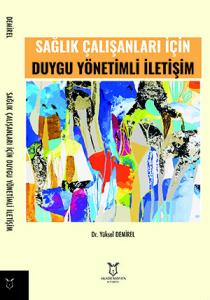
Sağlık Çalışanları için Duygu Yönetimli İletişim
Özet
Dr. Yüksel Demirel tarafından kaleme alınan Sağlık Çalışanları İçin Duygu Yönetimli İletişim adlı eser, özellikle insan ilişkilerinin ve duygusal iş yükünün yoğun olduğu sağlık sektöründe duygu yönetiminin ve sağlıklı iletişimin önemini ele almaktadır. Kitap, duyguların bastırılması yerine doğru yönetilmesinin hem çalışanların ruhsal ve fiziksel sağlığını koruyacağını hem de hasta memnuniyetini artırarak tıbbi hataların önüne geçeceğini vurgulamaktadır. Eserde kıskançlık, hırs, bıkkınlık, hayal kırıklığı ve kaygı gibi yıkıcı ve tüketici duyguların insan zihni ve ilişkileri üzerindeki olumsuz etkileri detaylandırılmakta; bu duygularla başa çıkabilmek için nefes kontrolü, dürtü denetimi ve anı yaşama (farkındalık) gibi pratik stratejiler sunulmaktadır. Duygu yönetiminin doğuştan gelmeyen, erken yaşlardan itibaren öğrenilebilen bir yaşam becerisi olduğunu belirten yazar, okuyucuyu dış dünyayı veya diğer insanları değiştirmek yerine kendi davranışlarını esnetmeye ve öz benliğini keşfetmeye davet etmektedir.
Written by Dr. Yuksel Demirel, Emotion-Managed Communication for Healthcare Professionals addresses the importance of emotional management and healthy communication, particularly in the healthcare sector where interpersonal relations and emotional workloads are intense. The book emphasizes that managing emotions rather than suppressing them protects the mental and physical health of professionals while enhancing patient satisfaction and preventing medical errors. The work details the negative impacts of consuming emotions such as jealousy, ambition, burnout, disappointment, and anxiety on the human mind and relationships, offering practical strategies like breath control, impulse management, and living in the present moment (mindfulness) to cope with them. Stating that emotional management is not innate but a life skill learned from an early age, the author invites readers to adapt their own behaviors and discover their true authentic selves instead of trying to change the external world or other people.
Referanslar
Ann Dadich; Rebecca E. Olson, How and why emotions matter in interprofessional healthcare. International Journal of Work Organisation and Emotion (IJWOE), Vol. 8, No. 1, 2017
Ashkanasy, N.M., Zerbe, W.J., & Hartel, C.E.J. (2002). Managing Emotions in theWorkplace (1st ed.). Routledge. https://doi.org/10.4324/9781315290812
Buckman R. Communications and emotions. BMJ. 2002 Sep 28;325(7366):672.doi: 10.1136/bmj.325.7366.672. PMID: 12351345; PMCID: PMC1124207.
Grant VJ, Robinson T, Catena H, Eppich W, Cheng A. Difficult debriefingsituations: A toolbox for simulation educators. Med Teach. 2018 Jul;40(7):703-712. doi: 10.1080/0142159X.2018.1468558.
Crowe, M., Raval, V. V., Trivedi, S. S., Daga, S. S., & Raval, P. H. (2012). Processes of emotion communication and control: A comparison of India and the UnitedStates. Social Psychology, 43(4), 205–214. https://doi.org/10.1027/1864-9335/a000121
Curtis, K., Horton, K., & Smith, P. (2012). Student nurse socialisation incompassionate practice: A grounded theory study. Nurse EducationToday, 32(7), 790–795. https://doi.org/10.1016/j.nedt.2012.04.012
Dadich, A., & Olson, R.E. (2017). How and why emotions matter in interprofessional healthcare. International Journal of Work Organisation and Emotion, 8, 59-79.
Fussell, S. R. (Ed.). (2002). The verbal communication of emotions: Interdisciplinary perspectives. Lawrence Erlbaum Associates https://doi.org/10.4324/9781410606341
Hartel, C., Ashkanasy, N.M., & Zerbe, W. (Eds.). (2005). Emotions in Organizational Behavior (1st ed.). Psychology Press. https://doi.org/10.4324/9781410611895
Jette Joost Michaelsen, Health Services Research Unit, Department of Public Health, University of Copenhagen, Øster Farimagsgade 5A, building 15, PO Box 2099, DK-1014 Copenhagen K, Denmark.
Kramer, M. W., & Hess, J. A. (2002). Communication Rules for the Display of Emotions in Organizational Settings. Management Communication Quarterly, 16(1), 66-80. https://doi.org/10.1177/0893318902161003
Luff D, Martin EB Jr, Mills K, Mazzola NM, Bell SK, Meyer EC. Clinicians’ strategies for managing their emotions during difficult healthcare conversations. Patient Educ Couns. 2016 Sep;99(9):1461-6. doi: 10.1016/j.pec.2016.06.017. Epub 2016 Jun 28. PMID: 27423178.
Mann, S. (2004). ‘People-work’: emotion management, stress and coping. British Journal of Guidance & Counselling, 32(2), 205–221. https://doi.org/10.1080/0369880410001692247
Meyer, Elaine C. PhD, RN; Sellers, Deborah E. PhD; Browning, David M. MSW, BCD; McGuffie, Kimberly EdM; Solomon, Mildred Z. EdD; Truog, RobertD. MD
Planalp, S. (1999). Communicating emotion: Social, moral and cultural processes. New York: Cambridge University Press.
Scholl, W. (2013). The socio-emotional basis of human interaction and communication: How we construct our social world. Social Science Information, 52(1), 3-33. https://doi.org/10.1177/0539018412466607
Scott, C., & Myers, K. K. (2005). The socialization of emotion: Learning emotion management at the fire station. Journal of Applied Communication Research, 33, 67–92.
Theodosius, C. (2006). Recovering Emotion from Emotion Management. Sociology, 40(5), 893-910. https://doi.org/10.1177/0038038506067512
Webb, T. L., Miles, E., & Sheeran, P. (2012). Dealing with feeling: A meta-analysis of the effectiveness of strategies derived from the process model of emotion regulation.Psychological Bulletin, 138(4), 775–808. https://doi.org/10.1037/a0027600
Yayınlanan
Lisans
LisansBu İnternet Sitesi içeriğinde yer alan tüm eserler (yazı, resim, görüntü, fotoğraf, video, müzik vb.) Akademisyen Kitabevine ait olup, 5846 sayılı Fikir ve Sanat Eserleri Kanunu ve 5237 sayılı Türk Ceca Kanunu kapsamında korunmaktadır. Bu hakları ihlal eden kişiler, 5846 sayılı Fikir ve Sanat eserleri Kanunu ve 5237 sayılı Türk Ceza Kanununda yer alan hukuki ve cezai yaptırımlara tabi olurlar. Yayınevi ilgili yasal yollara başvurma hakkına sahiptir.
