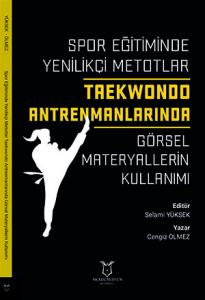
Spor Eğitiminde Yenilikçi Metotlar Taekwondo Antrenmanlarında Görsel Materyallerin Kullanımı
Özet
Bu kitap, spor eğitiminde yenilikçi metotlar ve taekwondo antrenmanlarında görsel materyallerin kullanımı konularını ele almaktadır. Taekwondo, çıplak el ve ayaklarla tüm vücudun kullanıldığı Kore kökenli bir mücadele sporudur. Kitap, taekwondonun tarihçesini, gelişimini ve günümüzdeki değişimlerini incelerken, spor eğitiminde kullanılan yenilikçi metotları ve görsel materyallerin etkisini ele almaktadır. Yazarlar, taekwondo antrenmanlarında video ve görsel materyallerin kullanımının teknik gelişime olan etkisini araştırmış ve bu konuda doktora tezi hazırlamışlardır. Kitap, taekwondo antrenörleri, spor eğitimi uzmanları ve taekwondo ile ilgilenen herkes için faydalı bir kaynak olmayı hedeflemektedir.
This book addresses innovative methods in sports education and the use of visual materials in taekwondo training. Taekwondo is a Korean martial art that utilizes bare hands and feet, involving the entire body. While examining the history, development, and contemporary changes in taekwondo, the book explores the impact of innovative methods and visual materials in sports education. The authors have conducted research on the influence of video and visual materials in taekwondo training for technical development, resulting in a doctoral thesis on this subject. The book aims to be a valuable resource for taekwondo coaches, sports education experts, and anyone interested in taekwondo.
Referanslar
Adam, C., Klissouras, V., Ravazzolo, M., Renson, R., Tuxworth, W., Kemper, H., Mechelen, W. van, Hlobil, H., Beunen, G., & Levarlet-Joye, H. (1993). EUROFIT - European test of physical fitness (2nd ed.). Council of Europe.
Ahn, J. D., Hong, S. ho, & Park, Y. K. (2009). The historical and cultural ıdentity of taekwondo as a traditional korean martial art. The International Journal of the History of Sport, 26(11), 1716–1734. https://doi.org/10.1080/09523360903132956
Akin Korhan, E., Tokem, Y., Uzelli̇ Yilmaz, D., & Di̇lemek, H. (2016). Hemşirelikte psikomotor beceri eğitiminde video destekli öğretim ve osce uygulaması: bir deneyim paylaşımı. İzmir Kâtip Çelebi Üniversitesi Sağlık Bilimleri Fakültesi Dergisi, 1(1), 35–37.
Alter, M. J. (2004). Science of flexibility. In Human Kinetics (3rd ed.). Human Kinetics.
Armstrong, N. (2013). Taekwondo: The unity of body, mind and spirit. Korea Foundation.
Bangsbo, J. (1994). Fitness training in football : a scientific approach. August Krogh Institute, University of Copenhagen.
Bangsbo, Jens, Iaia, F. M., & Krustrup, P. (2012). The Yo-Yo intermittent recovery test. Sports Medicine 2008 38:1, 38(1), 37–51. https://doi.org/10.2165/00007256-200838010-00004
Barak, M. (2010). Motivating self-regulated learning in technology education. International Journal of Technology and Design Education, 20(4), 381–401. https://doi.org/10.1007/s10798-009-9092-x
Bass, R. I. (2013). An analysis of the components of tests of semicircular canal function and of static and dynamic balance. Http://Dx.Doi.Org/10.1080/10671188.1939.10625750, 10(2), 33–52. https://doi.org/10.1080/10671188.1939.10625750
Baumgartner, T. A., Oh, S., Chung, H., & Hales, D. (2002). Objectivity, reliability, and validity for a revised push-up test protocol. Measurement in Physical Education and Exercise Science, 6(4), 225–242. https://doi.org/10.1207/S15327841MPEE0604_2
Bayköse, N., & Keskin, P. (2018). Boşluğa dokunmak filminin içerik açısından sporda psikolojik beceri faktörleri bağlamında incelenmesi. Ulusal Spor Bilimleri Dergisi, 2(1), 31–41. https://doi.org/10.30769/usbd.425167
Body mass index - BMI. (2019). World Health Organization.
Bompa, T. O., & Buzzichelli, C. (2018). Periodization-: theory and methodology of training. Human Kinetics.
Bridge, C. A., Ferreira Da Silva Santos, J., Chaabène, H., Pieter, W., & Franchini, E. (2014). Physical and physiological profiles of Taekwondo athletes. Sports Medicine, 44(6), 713–733. https://doi.org/10.1007/s40279-014-0159-9
Brzycki, M. (1993). Strength testing—predicting a one-rep max from reps-to-fatigue. Journal of Physical Education, Recreation & Dance, 64(1), 88–90. https://doi.org/10.1080/07303084.1993.10606684
Büyüköztürk, Ş., Kılıç Çakmak, E., Akgün, Ö. E., Karadeniz, Ş., & Demirel, F. (2018). Bilimsel Araştırma Yöntemleri (25th ed.). Pegem Akademi. https://doi.org/10.14527/9789944919289
Castro-Piñero, J., González-Montesinos, J. L., Mora, J., Keating, X. D., Girela-Rejón, M. J., Sjöström, M., & Ruiz, J. R. (2009). Percentile values for muscular strength field tests in children aged 6 to 17 Years: Influence of weight status. Journal of Strength and Conditioning Research, 23(8), 2295–2310. https://doi.org/10.1519/JSC.0b013e3181b8d5c1
Cejudo Palomo, A., San Cirilo Soriano, B., Robles Palazón, F. J., & Saiz De Baranda, M. D. P. (2018). Analysis of the flexibility profile in young taekwondo athletes. Revista de Artes Marciales Asiáticas, 13(2s), 33. https://doi.org/10.18002/rama.v13i2s.5503
Chen, C.-Y., Dai, J., Chen, I.-F., Chou, K.-M., & Chang, C.-K. (2015). Reliability and validity of a dual-task test for skill proficiency in roundhouse kicks in elite taekwondo athletes. Open Access Journal of Sports Medicine, 6, 181–189. https://doi.org/10.2147/OAJSM.S84671
Chi, E. H., Song, J., & Corbin, G. (2004). Killer App of wearable computing: wireless force sensing body protectors for martial arts. 285. https://doi.org/10.1145/1029632.1029680
Chiodo, S., Tessitore, A., Cortis, C., Lupo, C., Ammendolia, A., Iona, T., & Capranica, L. (2011). Effects of official taekwondo competitions on all-out performances of elite athletes. Journal of Strength and Conditioning Research, 25(2), 334–339. https://doi.org/10.1519/JSC.0b013e3182027288
Chiu, P.-H., Wang, H.-H., & Chen, Y.-C. (2007). Designing a measurement system for taekwondo training. Journal of Biomechanics, 40, S619. https://doi.org/10.1016/s0021-9290(07)70607-3
Chun, R. (2006). Advancing in Taekwondo. YMAA Publication Center.
Conconi, F., Ferrari, M., Ziglio, P., Droghetti, P., & Codeca, L. (1982). Determination of the anaerobic threshold by a noninvasive field test in runners. Journal of Applied Physiology: Respiratory, Environmental and Exercise Physiology, 52(4), 869–873. https://doi.org/10.1152/JAPPL.1982.52.4.869
Corbin, J., & Strauss, A. (2008). Basics of qualitative research: Techniques and procedures for developing grounded theory. In Canadian Journal of University Continuing Education (Vol. 3, Issue 2). Sage Publications Inc.
Cuberek, R., Machová, I., & Lipenská, M. (2013). Reliability of v sit-and-reach test used for flexibility self-assessment in females. Acta Gymnica, 43(1), 35–39.
DeMichele, P. L., Pollock, M. L., Graves, J. E., Foster, D. N., Carpenter, D., Garzarella, L., Brechue, W., & Fulton, M. (1997). Isometric torso rotation strength: Effect of training frequency on its development. Archives of Physical Medicine and Rehabilitation, 78(1), 64–69. https://doi.org/10.1016/S0003-9993(97)90012-5
Draeger, D. F., & Smith, R. W. (1980). Comprehensive Asian Fighting Arts (2nd ed.). Kodansha International.
Dündar, U. (2015). Antrenman Teorisi (9th ed.). Nobel.
Erim, A., & Yöndem, S. (2009). Video model destekli öğretimin gitar performansına etkisi. Dokuz Eylül Üniversitesi Buca Eğitim Fakültesi Dergisi, 26, 45–55.
Farrow, D., Chivers, P., Hardingham, C., & Sachse, S. (1998). The effect of video-based perceptual training on the tennis return of serve. International Journal of Sport Psychology, 29(3), 231–242.
Fong, S. S. M., Fu, S. ngor, & Ng, G. Y. F. (2012). Taekwondo training speeds up the development of balance and sensory functions in young adolescents. Journal of Science and Medicine in Sport, 15(1), 64–68. https://doi.org/10.1016/j.jsams.2011.06.001
Fong, S. S. M., & Ng, G. Y. F. (2011). Does taekwondo training improve physical fitness? Physical Therapy in Sport, 12(2), 100–106. https://doi.org/10.1016/j.ptsp.2010.07.001
Fox, E. L., & Mathews, D. K. (1974). Interval Training: Conditioning for Sports and General Fitness. Saunders.
Getchell, B. (1979). Physical Fitness: A Way of Life. In John Wiley and Sons, Inc. (2nd ed.). John Wiley & Sons, Inc.
Goudarzian, M., Ghavi, S., Shariat, A., Shirvani, H., & Rahimi, M. (2017). Effects of whole body vibration training and mental training on mobility, neuromuscular performance, and muscle strength in older men. Journal of Exercise Rehabilitation, 13(5), 573–580. https://doi.org/10.12965/jer.1735024.512
Gribble, P. A., & Hertel, J. (2009). Considerations for normalizing measures of the star excursion balance test. Https://Doi.Org/10.1207/S15327841MPEE0702_3, 7(2), 89–100. https://doi.org/10.1207/S15327841MPEE0702_3
Gribble, P. A., Kelly, S. E., Refshauge, K. M., & Hiller, C. E. (2013). Interrater reliability of the star excursion balance test. Journal of Athletic Training, 48(5), 621–626. https://doi.org/10.4085/1062-6050-48.3.03
Günay, M., Tamer, K., & Cicioğlu, İ. (2013). Spor Fizyolojisi ve Performans Ölçümü (İ. Cicioğlu (Ed.); 3rd ed.). Gazi Kitabevi.
Guyton, A. C. (1958). Textbook of Medical Physiology. Southern Medical Journal, 51(3), 412. https://doi.org/10.1097/00007611-195803000-00032
Harman, E. A., Rosenstein, M. T., Frykman, P. N., Rosenstein, R. M., & Kraemer, W. J. (1991). Estimation of human power output from vertical jump. Journal of Strength and Conditioning Research, 5(3), 116–120.
Harman, E., Garhammer, J., & Pandorf, C. (2000). Administration, scoring and interpretation of selected tests. In T. R. Baechle & R. W. Earle (Eds.), Essentials of Strength and Conditioning (Vol. 2). Human Kinetics.
Hedelin, R., Kenttá, G., Wiklund, U., Bjerle, P., & Henriksson-Larsén, K. (2000). Short-term overtraining: effects on performance, circulatory responses, and heart rate variability. Medicine & Science in Sports & Exercise, 32(8), 1480–1484.
Hertel, J., Miller, S. J., & Denegar, C. R. (2000). Intratester and intertester reliability during the Star Excursion Balance Tests. Journal of Sport Rehabilitation, 9(2), 104–116. https://doi.org/10.1123/JSR.9.2.104
Heyward, V. (2002). Advanced Fitness Assessment & Exercise Prescription (4th ed.). Human Kinetics. https://www.amazon.com/Advanced-Assessment-Prescription-4th-Publishers-Hardcover/dp/B00M3V74QM
Hortobágyi, T., Houmard, J. A., Stevenson, J. R., Fraser, D. D., Johns, R. A., & Israel, R. G. (1993). The effects of detraining on power athletes. Medicine and Science in Sports and Exercise, 25(8), 929–935. https://doi.org/10.1249/00005768-199308000-00008
Irurtia, A., Busquets, A., Carrasco, M., Ferrer, B., & Marina, M. (2010). Flexibility testing in young competing gymnasts using a trigonometric method: one-year follow-up. Apunts Med Esport, 45(168), 235–242. www.apunts.org
Jacobs, I., Tesch, P. A., Bar-Or, O., Karlsson, J., & Dotan, R. (1983). Lactate in human skeletal muscle after 10 and 30 s of supramaximal exercise. Journal of Applied Physiology Respiratory Environmental and Exercise Physiology, 55(2), 365–367. https://doi.org/10.1152/jappl.1983.55.2.365
Johnson, B. L., & Nelson Jack K. (1969). Practical measurements for evaluation in physical education. Burgess Publishing Company.
Johnson, D. L., & Bahamonde, R. (1996). Power output estimate in university athletes. Journal of Strength and Conditioning Research, 10(3), 161–166.
Kahveci, G. (2017). Çoklu yetersizliklerde doğrudan öğretim ile gerçekleştirilen görsel kart ve video temelli öğretim yaklaşımlarının renk öğretiminde karşılaştırmalı etkililiği. Electronic Turkish Studies, 12(23), 133–150.
Kim, J. W., Kwon, M. S., Yenuga, S. S., & Kwon, Y. H. (2010). The effects of target distance on pivot hip, trunk, pelvis, and kicking leg kinematics in Taekwondo roundhouse kicks. Sports Biomechanics, 9(2), 98–114. https://doi.org/10.1080/14763141003799459
Kim, M. (2011). Taekwondo Defense Against Weapons. Ymaa Publication Center. www.ymaa.com
Kim, S. H., Chung, K. H., & Lee, K. M. (1999). Taekwondo Kyorugi: Olympic Style Sparring (2nd ed.). Turtle Press.
Kim, Y.-H., & Khil, J.-H. (2010). Effects of 12 week’s taekwondo combined exercise program on body composition and physical fitness in middle aged obese women. The Official Journal of the Korean Academy of Kinesiology, 12(2), 67–77.
Koku, F. E. (2015). Sportif performansın genetik ile ilişkisi. Spor Hekimliği Dergisi, 50(1), 21–30.
Kramarski, B., & Mizrachi, N. (2006). Online discussion and self-regulated learning: effects of instructional methods on mathematical literacy. Journal of Educational Research, 99(4), 218–231. https://doi.org/10.3200/JOER.99.4.218-231
Kurtoğlu, S., Tekinarslan, E., & Çifci Tekinarslan, İ. (2017). Zihinsel yetersizliği olan bireylere bankamatikten para çekme becerisinin öğretiminde bilgisayar destekli video öğretiminin etkililiği. Ankara Üniversitesi Eğitim Bilimleri Fakültesi Özel Eğitim Dergisi, 18(02), 1–1. https://doi.org/10.21565/ozelegitimdergisi.321627
Kwon, C., Lee, S., Park, J., & Johnson, J. A. (2019). An estimation model for anaerobic power of taekwondo athletes based on field tests. Ido Movement for Culture, 19(1), 34–50. https://doi.org/10.14589/ido.19.1.4
Léger, L. A., Mercier, D., Gadoury, C., & Lambert, J. (1988). The multistage 20 metre shuttle run test for aerobic fitness. Journal of Sports Sciences, 6(2), 93–101. https://doi.org/10.1080/02640418808729800
Leong, H. T., Fu, S. N., Ng, G. Y. F., & Tsang, W. W. N. (2011). Low-level taekwondo practitioners have better somatosensory organisation in standing balance than sedentary people. European Journal of Applied Physiology, 111(8), 1787–1793. https://doi.org/10.1007/s00421-010-1798-7
Lodder, J. (2012). Sekwondo: World Taekwondo Federation Taekwondo Initiation for Novices Over. Strategic Book Publishing and Rights Co.
Macaulay, K., & Kalman, B. (2005). Taekwondo in Action. Crabtree Publishing Company.
MacKinnon, L. T. (2000). Overtraining effects on immunity and performance in athletes. Immunology and Cell Biology, 78(5), 502–509. https://doi.org/10.1111/j.1440-1711.2000.t01-7-.x
Malouin, F., Richards, C. L., & Durand, A. (2010). Normal aging and motor imagery vividness: implications for mental practice training in rehabilitation. Archives of Physical Medicine and Rehabilitation, 91(7), 1122–1127. https://doi.org/10.1016/j.apmr.2010.03.007
Marković, G., Mišigoj-Duraković, M., & Trninić, S. (2005). Fitness profile of elite croatian female taekwondo athletes. Collegium Antropologicum, 29(1), 93–99.
Mayhew, J., Johnson, B., Lamonte, M., Lauber, D., & Kemmler, W. (2008). Accuracy of prediction equations for determining one repetition maximum bench press in women before and after resistance training. Journal of Strength and Conditioning Research, 22(5), 1570–1577. https://doi.org/10.1519/JSC.0B013E31817B02AD
Mazur, L. J., Yetman, R. J., & Risser, W. L. (1993). Weight-training injuries. Sports Medicine, 16(1), 57–63. https://doi.org/10.2165/00007256-199316010-00005
Mujika, I, & Padilla, S. (2001). Muscular characteristics of detraining in humans. Medicine and Science in Sports and Exercise, 33(8), 1297–1303.
Mujika, Iñigo, & Padilla, S. (2000). Detraining: loss of training induced physiological and performance adaptations. Part 1. Sports Medicine, 30(2), 79–87. https://doi.org/10.2165/00007256-200030020-00002
Muratlı, S., Kalyoncu, O., & Şahin, G. (2007). Antrenman ve müsabaka. Ladin Matbaası.
Myerson, A., & Neustadt, R. (1939). Influence of ultraviolet radiation on excretion of sex hormones in the male. Endocrinology, 25, 7–12. https://doi.org/10.1210/endo-25-1-7
Nikolaidis, P. T., Busko, K., Clemente, F. M., Tasiopoulos, I., & Knechtle, B. (2016). Age- and sex-related differences in the anthropometry and neuromuscular fitness of competitive taekwondo athletes. Open Access Journal of Sports Medicine, 7(1), 177–186. https://doi.org/10.2147/oajsm.s120344
Ölmez, C. (2017). Müzikli ritim çalışmaları ile yapılan taekwondo eğitiminin çocukların teknik ve motorik gelişimlerine etkisi (Yayınlanmamış yüksek lisans tezi). Karadeniz Teknik Üniversitesi, Trabzon.
Ölmez, C. (2021). Determining the motor skills affecting the distance to the opponent in taekwondo. Pakistan Journal of Medical and Health Sciences, 15(10), 2999–3003. https://doi.org/10.53350/PJMHS2115102999
Ölmez, C., Ayan, V., Yüksek, S., Öztaş, M., & Civil, T. (2019). 11-13 yaş erkek taekwondo sporcularının somatotip yapıları ve performans özellikleri arasındaki ilişkinin incelenmesi. Ulusal Spor Bilimleri Dergisi, 3(1), 1–13.
Ölmez, C., Yüksek, S., & Ayan, V. (2018). Çocuklarda taekwondo eğitiminin motorik performans özelliklerine etkisi. 16th International Sport Sciences Congress, 127–131.
Ouergui, I., Messaoudi, H., Chtourou, H., Wagner, M. O., Bouassida, A., Bouhlel, E., Franchini, E., & Engel, F. A. (2020). Repeated sprint training vs. repeated high-intensity technique training in adolescent taekwondo athletes- a randomized controlled trial. International Journal of Environmental Research and Public Health, 17(12), 4506. https://doi.org/10.3390/ijerph17124506
Özdal, M., Akcan, F., Abakay, U., & Dağlıoğlu, Ö. (2013). Video destekli zihinsel antrenman programının futbolda şut becerisi üzerine etkisi. Spor ve Performans Araştırmaları Dergisi, 4(2), 40–46. https://doi.org/10.17155/spd.00962
Park, Y., & Gerrard, J. (2013). Black Belt Tae Kwon Do: The Ultimate Reference Guide to the World’s Most. Skyhorse Publishing Inc.
Peterson, M. D., Rhea, M. R., & Alvar, B. A. (2005). Applications of the dose-response for muscular strength development: A review of meta-analytic efficacy and reliability for designing training prescription. Journal of Strength and Conditioning Research, 19(4), 950–958. https://doi.org/10.1519/R-16874.1
Pieter, F., & Pieter, W. (1995). Speed and force in selected taekwondo techniques. Biology of Sport, 12, 257–266.
Pieter, W. (2009). Taekwondo. In R. Kordi, N. Maffuli, R. Wroble, & Wallacei WA (Eds.), Combat Sports Medicine (pp. 263–286). Springer. https://doi.org/10.1007/978-1-84800-354-5
Pion, J., Fransen, J., Lenoir, M., & Segers, V. (2014). The value of non-sport-specific characteristics for talent orientation in young male judo, karate and taekwondo athletes. Archives of Budo, 10(1), 154.
Pollock, M. L., Carroll, J. F., Graves, J. E., Leggett, S. H., Braith, R. W., Limacher, M., & Hagberg, J. M. (1991). Injuries and adherence to walk/jog and resistance training programs in the elderly. Medicine & Science in Sports & Exercise, 23(10), 1194–1200.
Şahin, M., Saraç, H., Çoban, O., & Coşkuner, Z. (2012). Taekwondo antrenmanlarının çocukların motor gelişim düzeylerine etkisinin incelenmesi. Spor ve Performans Araştırmaları Dergisi, 3(1), 5–14. https://www.researchgate.net/publication/325930506
Sánchez-Medina, L., & González-Badillo, J. J. (2011). Velocity loss as an indicator of neuromuscular fatigue during resistance training. Medicine and Science in Sports and Exercise, 43(9), 1725–1734. https://doi.org/10.1249/mss.0b013e318213f880
Sant’Ana, J., Diefenthaeler, F., Dal Pupo, J., Detanico, D., Guglielmo, L. G. A., & Santos, S. G. (2014). Anaerobic evaluation of taekwondo athletes. International SportMed Journal, 15(4), 492–499.
Santos, J. F. da S., & Franchini, E. (2018). Frequency speed of kick test performance comparison between female taekwondo athletes of different competitive levels. Journal of Strength and Conditioning Research, 32(10), 2934–2938. https://doi.org/10.1519/JSC.0000000000002552
Santos, J. F. da S., Herrera-Valenzuela, T., da Mota, G. R., & Franchini, E. (2016). Influence of half-squat intensity and volume on the subsequent countermovement jump and frequency speed of kick test performance in taekwondo athletes. Kinesiology, 48(1), 95–102. https://doi.org/10.26582/k.48.1.6
Santos, J. F. da S., Loturco, I., & Franchini, E. (2018). Relationship between frequency speed of kick test performance, optimal load, and anthropometric variables in black-belt taekwondo athletes. Ido Movement for Culture, 18(1), 39–44. https://doi.org/10.14589/ido.18.1.6
Santos, J. F., & Franchini, E. (2016). Is frequency speed of kick test responsive to training? A study with taekwondo athletes. Sport Sciences for Health, 12(3), 377–382. https://doi.org/10.1007/s11332-016-0300-2
Savoie, G. (2010). Taekwondo: A Technical Manual. Blue Snake Books.
Sevim, Y. (2003). Basketbolda Kondisyon Antrenmanı (3rd ed.). Nobey Yayın Dağıtım.
Singh, A., Sathe, A., & Sandhu, J. (2017). Effect of a 6-week agility training program on performance indices of Indian taekwondo players. Saudi Journal of Sports Medicine, 17(3), 143. https://doi.org/10.4103/sjsm.sjsm_19_17
Sohn, H., & Yang, H. (2004). Selected Readings in Korean. University of Hawaii Press.
Song, J. K. ., Han, D. J. ., Jung, H. C. ., Kang, H. J. ., Seo, M. W. ., Clarke, J. A. ., & Kim, H. B. (2015). Does pre-season training improve body composition, physical fitness, and isokinetic muscle strength in female taekwondo athletes? Acta Taekwondo et Martialis Artium (JIATR), 2(1), 6–15.
Srinivas-Shankar, U., Roberts, S. A., Connolly, M. J., O’Connell, M. D. L., Adams, J. E., Oldham, J. A., & Wu, F. C. W. (2010). Effects of testosterone on muscle strength, physical function, body composition, and quality of life in ıntermediate-frail and frail elderly men: a randomized, double-blind, placebo-controlled study. The Journal of Clinical Endocrinology & Metabolism, 95(2), 639–650. https://doi.org/10.1210/jc.2009-1251
Sungur, S., & Tekkaya, C. (2006). Effects of problem-based learning and traditional instruction on self-regulated learning. Journal of Educational Research, 99(5), 307–320. https://doi.org/10.3200/JOER.99.5.307-320
Tanrıverdi, H., & Köksal, G. (2018). Etnografik Araştırma. In Ş. Aslan (Ed.), Sosyal Bilimlerde Araştırma Yöntemleri (1st ed., pp. 250–251). Eğitim Yayınevi.
Tedeschi, M. (2004). Taekwondo : Complete WTF Forms. Weatherhill.
Türkiye Taekwondo Federasyonu. (2020, May 8). Taekwondo ve Tarihçe. https://www.turkiyetaekwondofed.gov.tr/default.asp?SayfaID=10
Vikipedi. (2020). 2000 Yaz Olimpiyatlarında Türkiye. http://wiki.pinsify.xyz/index.php?q=aHR0cHM6Ly90ci53aWtpcGVkaWEub3JnL3dpa2kvMjAwMF9ZYXpfT2xpbXBpeWF0bGFyJUM0JUIxJTI3bmRhX1QlQzMlQkNya2l5ZQ
Weir, J. P., Wagner, L. L., & Housh, T. J. (1994). The effect of rest interval length on repeated maximal bench presses. The Journal of Strength & Conditioning Research, 8(1), 58–60.
Wood, R. (2008). Speed or sprint testing. http://www.topendsports.com/testing/tests/sprint.htm
World Taekwondo Europe - European Taekwondo Union | Home. (2020, May 7). https://www.worldtaekwondoeurope.org/#ETU-Newspage
World Taekwondo Federation. (2018). rules. http://www.worldtaekwondo.org/wp-content/uploads/2018/06/Revision-WT-Competition-Rules-Interpretation-Hammamet-040520181.pdf
Wu, Y.-N., Tsai, M.-C., & Chiu, P.-K. (2016). Case Study in Technical Patterns for an Elite Female Taekwondo. Journal of Taekwondo Sports, 3, 1–9. https://doi.org/10.3966/251969952016120003001
Xiang-jun, L. I. (2014). Study on Development Trend of Taekwondo Tactical From the16th Asian Games of Taekwondo Competition. Journal of Lanzhou University of Arts and Science (Natural Science Edition), 5, 20.
Xiangjun, L. I. (2012). Score Skills of the 16th Asian Games of Taekwondo Competition in New Rules. Journal of Shenyang Sport University, 2, 34.
Yassi, A., Kjellström, T., Kok, T., & Guidotti, T. (2001). Basic Environmental Health. Oxford University Press.
Yavuz, S., & Coşkun, A. E. (2008). Sınıf öğretmenliği öğrencilerinin eğitimde teknoloji kullanımına ilişkin tutum ve düşünceleri. Hacettepe Üniversitesi Eğitim Fakültesi Dergisi, 34(19), 276–286.
Yibo, L., & Minghong, W. (2012). On the Influence of New Rules upon Techniques Application of China Tae Kwon Do Players. Wushu Science, 5, 31.
Yıldırım, A., & Şimşek, H. (2013). Sosyal bilimlerde nitel araştırma yöntemleri (S. Yayıncılık (Ed.); 9th ed.).
Yüksek, S., Akpınar, E., Ayan, V., & Ölmez, C. (2017). 14-16 yaş yüzücülerin antropometrik özellikleri ile sırtüstü yüzme performansları arasındaki ilişkinin incelenmesi. İstanbul Üniversitesi Spor Bilimleri Dergisi, 7(2), 1303–1414.
Yüksek, Selami, & Ölmez, C. (2020). Development of Olmez & Yuksek taekwondo kyorugi performance evaluation scale. Research in Sports Science, 10(1), 1–6. https://doi.org/10.5152/rss.2020.20004
Zagatto, A. M., Beck, W. R., & Gobatto, C. A. (2009). Validity of the running anaerobic sprint test for assessing anaerobic power and predicting short-distance performances. Journal of Strength and Conditioning Research, 23(6), 1820–1827. https://doi.org/10.1519/JSC.0B013E3181B3DF32
Zengin, D., & Yardimci, F. (2017). Hemşirelikte Pediatrik Tanılama Becerisi Kazandırmada Video İle Eğitimin Etkinliğinin Değerlendirilmesi. Dokuz Eylül Üniversitesi Hemşirelik Fakültesi Elektronik Dergisi, 10(4), 267–274.
Yayınlanan
Lisans
LisansBu İnternet Sitesi içeriğinde yer alan tüm eserler (yazı, resim, görüntü, fotoğraf, video, müzik vb.) Akademisyen Kitabevine ait olup, 5846 sayılı Fikir ve Sanat Eserleri Kanunu ve 5237 sayılı Türk Ceca Kanunu kapsamında korunmaktadır. Bu hakları ihlal eden kişiler, 5846 sayılı Fikir ve Sanat eserleri Kanunu ve 5237 sayılı Türk Ceza Kanununda yer alan hukuki ve cezai yaptırımlara tabi olurlar. Yayınevi ilgili yasal yollara başvurma hakkına sahiptir.