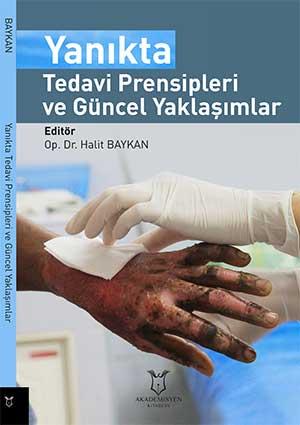
Yanık Sınıflaması Teşhis ve Tedavi Planı
Özet
Aşırı ısının ciltte meydana getirdiği hasarlanmalar olarak tanımlanan yanıklar; oluş mekanizmalarına göre termal, elektrik, sürtünme, kimyasal ve radyasyon kaynaklı olarak sınıflandırılmaktadır. Doku hasarının derinliği, tedavi planlaması ve cerrahi greft ihtiyacını belirlemede en kritik unsur olup; güncel yaklaşımla yüzeysel, yüzeysel kısmi kalınlık, derin kısmi kalınlık ve tam kalınlık olarak dört grupta değerlendirilmektedir. Yanık boyutunun doğru hesaplanması, hastanın tedavi sürecini veya bir yanık merkezine sevk edilip edilmeyeceğini doğrudan etkiler; bu amaçla klinik uygulamalarda Lund-Browder şeması, "Dokuzlar Kuralı" ve avuç içi yöntemi gibi çeşitli tahmin metotları aktif olarak kullanılmaktadır. Yanık yaralanmalarının ciddiyeti ise yanığın mekanizması, derinliği, toplam vücut yüzey alanı (TVYA) yüzdesi ve anatomik yerleşimi temel alınarak küçük, orta ve şiddetli olmak üzere üç ana sınıfta kategorize edilir. Tedavi protokollerinde, birinci derece yanıklarda nemlendirici ve analjezik kullanımı yeterli olurken; yüzeysel kısmi kalınlıktaki yanıklar pansuman takibiyle, derin kısmi kalınlıkta olanlar antibiyotikli kremler veya cerrahi müdahaleyle, tam kalınlıktaki ağır yanıklar ise erken debridman ve greftleme gibi kapsamlı cerrahi yöntemlerle yönetilmektedir.
Burns, defined as skin damage caused by excessive heat, are classified according to their occurrence mechanisms as thermal, electrical, friction, chemical, and radiation-induced. The depth of tissue damage is the most critical factor in determining the treatment plan and the need for surgical grafting; in the current approach, it is evaluated in four groups as superficial, superficial partial-thickness, deep partial-thickness, and full-thickness. Accurate estimation of the burn size directly affects the patient's treatment process or whether they will be referred to a burn center; for this purpose, various estimation methods such as the Lund-Browder chart, the "Rule of Nines," and the palm method are actively used in clinical practices. The severity of burn injuries is categorized into three main classes as minor, moderate, and severe, based on the burn mechanism, depth, total body surface area (TBSA) percentage, and anatomical location. In treatment protocols, the use of moisturizers and analgesics is sufficient for first-degree burns; while superficial partial-thickness burns are managed with dressing follow-up, deep partial-thickness burns are treated with antibiotic creams or surgical intervention, and severe full-thickness burns require comprehensive surgical methods such as early debridement and grafting.
Referanslar
Kagan RJ, Peck MD, Ahrenholz DH, et al. Surgical management of the burn wound and use of skin substitutes: an expert panel white paper. J Burn Care Res Off Publ Am Burn Assoc. 2013;34(2):e60-79. doi:10.1097/BCR.0b013e31827039a6
Orgill DP, Solari MG, Barlow MS, O’Connor NE. A finite-element model predicts thermal damage in cutaneous contact burns. J Burn Care Rehabil. 1998;19(3):203-209. doi:10.1097/00004630-199805000-00003
Mertens DM, Jenkins ME, Warden GD. Outpatient burn management. Nurs Clin North Am. 1997;32(2):343-364.
Baxter CR. Management of burn wounds. Dermatol Clin. 1993;11(4):709-714.
Pham T. Evauation of the burn wound: management decisions. In: Total Burn Care. 3rd ed. Saunders Elsevier.
Orgill DP. Excision and skin grafting of thermal burns. N Engl J Med. 2009;360(9):893-901. doi:10.1056/NEJMct0804451
LC Woodson. Anesthesia for burned patients. In: Total Burn Care. 3rd ed. Saunders Elsevier; :196.
Lund CC, Browder NC. The estimation of areas of burn. Surg Gynecol Obstet. 1944;79:352.
Monafo WW. Initial management of burns. N Engl J Med. 1996;335(21):1581-1586. doi:10.1056/NEJM199611213352108
Wachtel TL, Berry CC, Wachtel EE, Frank HA. The inter-rater reliability of estimating the size of burns from various burn area chart drawings. Burns J Int Soc Burn Inj. 2000;26(2):156-170. doi:10.1016/s0305-4179(99)00047-9
Perry RJ, Moore CA, Morgan BD, Plummer DL. Determining the approximate area of a burn: an inconsistency investigated and re-evaluated. BMJ. 1996;312(7042):1338. doi:10.1136/bmj.312.7042.1338
Sheridan RL, Petras L, Basha G, et al. Planimetry study of the percent of body surface represented by the hand and palm: sizing irregular burns is more accurately done with the palm. J Burn Care Rehabil. 1995;16(6):605-606. doi:10.1097/00004630-199511000-00008
Nagel TR, Schunk JE. Using the hand to estimate the surface area of a burn in children. Pediatr Emerg Care. 1997;13(4):254-255. doi:10.1097/00006565-199708000-00003
O’Brien SP, Billmire DA. Prevention and management of outpatient pediatric burns. J Craniofac Surg. 2008;19(4):1034-1039. doi:10.1097/SCS.0b013e318177217c
TC. Sağlık Bakanlığı Yanık Yaralanmaları Tedavi Algoritması. Published online 2012.
Hussain A. Surgical treatment of acute burns. Wounds UK. 2013;9(4):54-59.
Patel PP, Vasquez SA, Granick MS, Rhee ST. Topical antimicrobials in pediatric burn wound management. J Craniofac Surg. 2008;19(4):913-922. doi:10.1097/SCS.0b013e318175b516