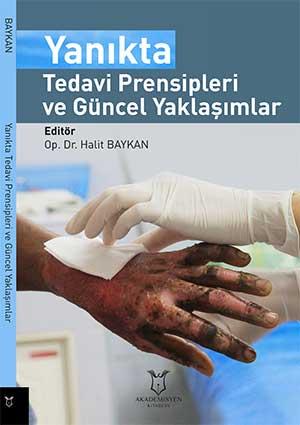
Yanık Hastasında Anestezi ve Ağrı Yönetimi
Özet
Majör yanık yaralanmaları, ilk 24-48 saatte yanık şoku, myokardiyal depresyon, artan vasküler direnç ve üçüncü boşluğa sıvı kaybı ile karakterize sistemik, hemodinamik ve patofizyolojik değişikliklere neden olur. Bu süreçte GFR artsa da tübüler hasar maskelenebilir, hipoksiye bağlı SSS disfonksiyonu, koagülopati ve bağışıklık baskılanması nedeniyle enfeksiyon eğilimi gelişebilir. Perioperatif yönetimde invaziv monitörizasyon zorlukları, supraglottik ödem ve kimyasal hasara bağlı havayolu ve akciğer koruyucu ventilasyon gereksinimleri öne çıkar. Sıvı resüsitasyonu Parkland formülüyle idrar çıkışına göre titre edilirken, ısı kaybını önlemek için agresif ısıtma stratejileri ve yakın takip şarttır. İndüksiyonda hiperpotasemi riski nedeniyle süksinilkolinden kaçınılarak rokuronyum tercih edilmeli; propofolün hipotansif, etomidatın ise mortaliteyle ilişkili adrenal baskılayıcı etkileri bilinerek, sempatik stimülasyon sağlayan ketamin gibi uygun ajanlar seçilmelidir. Anestezi idamesinde artan ilaç dağılım hacmi ve opioid toleransı gözetilmeli; nosiseptif ile nöropatik özellik gösteren yanık ağrısının multidisipliner yönetiminde opioidlerin yanı sıra ketamin, deksmedetomidin, lidokain, gabapentin ve rejyonal blokları içeren multimodal analjezi stratejileri uygulanmalıdır.
Major burn injuries cause systemic, hemodynamic, and pathophysiological alterations characterized by burn shock, myocardial depression, increased vascular resistance, and third-space fluid loss within the first 24-48 hours. Although GFR increases, tubular damage may be masked, and CNS dysfunction due to hypoxia, coagulopathy, and immunosuppression can predispose patients to infections. Perioperative management highlights invasive monitoring difficulties, alongside airway and lung-protective ventilation requirements driven by supraglottic edema and chemical inhalation injury. Fluid resuscitation is titrated via the Parkland formula based on urine output, while aggressive warming strategies and close monitoring are mandatory to prevent heat loss. During induction, succinylcholine must be avoided due to hyperkalemia risks, making rocuronium the preferred alternative; induction agents must be selected carefully, considering propofol's hypotensive and etomidate's mortality-associated adrenal-suppressive effects, whereas ketamine is favorable for providing sympathetic stimulation. Maintenance of anesthesia requires addressing increased volume of distribution and opioid tolerance; managing burn pain, which exhibits nociceptive and neuropathic traits, necessitates multimodal analgesia strategies incorporating opioids alongside ketamine, dexmedetomidine, lidocaine, gabapentin, and regional nerve blocks.
Referanslar
Hill NE, Mahboobi SK. Anesthesia For Patients With Burns. StatPearls [Internet] 2021
Anderson TA, Fuzaylov G. Manangement of burns, an issue of clinics, e-book.2014:852-61.
Bittner EA, Shank E, Woodson L, Martyn JA. Acute and perioperative care of the burn-injured patient. Anesthesiology. 2015 Feb;122(2):448-64.
Snell JA, Loh NH, Mahambrey T, Shokrollahi K. Clinical review: the critical care management of the burn patient. Crit Care. 2013 Oct 07;17(5):241. [PMC free article] [PubMed]
Sommerhalder C, Blears E, Murton AJ, Porter C, Finnerty C, Herndon DN. Current problems in burn hypermetabolism. Curr Probl Surg. 2020 Jan;57(1):100709.
BrownKL, Wilson RF, WhiteMT. Carbon monoxide- induced status epilepticusin an adult. J Burn Care Res 2007;28:533-6.
Rowan MP, Cancio LC, Elster EA, Burmeister DM, Rose LF, Natesan S, Chan RK, Christy RJ, Chung KK. Burn wound healing and treatment: review and advancements. Crit Care. 2015 Jun 12;19:243.
Alebachew T, Yismaw G, Derabe A, Sisay Z. Staphylococcus aureus burn wound infection among patients attending yekatit 12 hospital burn unit, addis ababa, ethiopia. Ethiop J Health Sci. 2012 Nov;22(3):209-13.
Church D, Elsayed S, Reid O, Winston B, Lindsay R. Burn wound infections. Clin Microbiol Rev. 2006 Apr;19(2):403-34.
Foncerrada G, Culnan DM, Capek KD, González-Trejo S, Cambiaso-Daniel J, Woodson LC, Herndon DN, Finnerty CC, Lee JO. Inhalation Injury in the Burned Patient. Ann Plast Surg. 2018 Mar;80(3 Suppl 2):S98-S105.
Holm C. Resuscitation in shock associated with burns. Tradition or evidence based medicine? Resuscitation 2000;44:157-64.
Gigengack RK, Cleffken BI, Loer SA. Advances in airway management and mechanical ventilation in inhalation injury. Curr Opin Anaesthesiol. 2020 Dec;33(6):774-780.
Greenhalgh DG. Burn resuscitation. J Burn Care Res 2007;28(4):555-65.
Blumetti J, Hunt JL, Arnoldo BD, et al. The Parkland formula under fire: is the criticism justified? J Burn Care Res 2008;29(1):180-6.
Ikeda T, Sessler DI, Kikura M, Kazama T, Ikeda K, Sato S. Less core hypothermia when anesthesia is induced with inhaled sevoflurane than with intravenous propofol. Anesth Analg. 1999 Apr;88(4):921-4.
Díaz M, Becker DE. Thermoregulation: physiological and clinical considerations during sedation and general anesthesia. Anesth Prog. 2010 Spring;57(1):25-32; quiz 33-4.
Han T, Kim H, Bae J, Kim K, Martyn JA. Neuromuscular pharmacodynamics of rocuronium in patients with major burns. Anesth Analg. 2004 Aug;99(2):386-92, table of contents.
Osta WA, El-Osta MA, Pezhman EA, Raad RA, Ferguson K, McKelvey GM, Marsh HM, White M, Perov S. Nicotinic acetylcholine receptor gene expression is altered in burn patients. Anesth Analg. 2010 May 01;110(5):1355-9.
Nosek MT, Martyn JA. Na+ channel and acetylcholine receptor changes in muscle at sites distant from burns do not simulate denervation. J Appl Physiol (1985). 1997 Apr;82(4):1333-9.
Canpolat DG, Esmaoglu A, Tosun Z, et al. Ketamin-propofol vs ketamine-dexmedetomidine combinations in pediatric patients undergoing burn dressing changes. J Burn Care Res 2008;29(1):180-6.
Sen S, Greenhalgh D, Palmieri T. Review of burn ijury research for the year 2009. J Burn Care Res 2010;31(6):836-48.
Romanowski KS, Carson J, Pape K, et al. American Burn Association Guidelines on the Management of Acute Pain in the Adult Burn Patient: A Review of the Literature, a Compilation of Expert Opinion, and Next Steps. Journal of Burn Care & Research 2020;41(6):1129-51.
Gamst-Jensen H et al. Acute pain management in burn patients: appraisal and thematic analysis of four clinical guidelines. Burns 2014;40(8):1463–9.
Faucher L, Furukawa K. Practice guidelines for the management of pain. J Burn Care Res 2006;27(5):659–668.