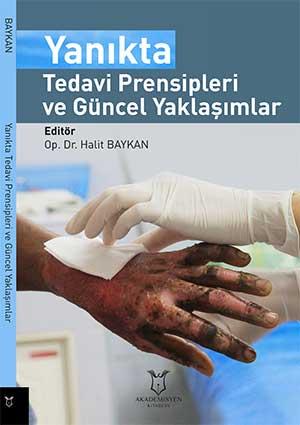
Yanıkta Greft ve Fleple Tedavi
Özet
Yanık travması sonrası uygulanacak cerrahi yöntemlerin belirlenmesinde derinlik, genişlik ve anatomik lokalizasyon kritik rol oynamaktadır. Yüzeyel minör yanıklar ayaktan pansumanlarla kısa sürede epitelize olabilirken, ikinci derece derin ve üçüncü derece yanıklarda eksizyon sonrası oluşan defektlerin greft veya fleplerle kapatılması zorunludur. Granüle, enfeksiyonsuz ve hayati yapıların açıkta olmadığı yataklarda sıklıkla yarım veya tam kalınlıkta otolog deri greftleri tercih edilir; geniş yanıklarda ise donör alan yetersizliğini aşmak için greftler mesh makinesiyle genişletilir. İmmünsistemin baskılandığı akut dönemde allogreft, ksenogreft veya amniyon zarları geçici biyolojik pansuman olarak kullanılabilmektedir. Greftin alıcı yatağa tutunması plazmatik imbibisyon, inokülasyon ve kapiller içe büyüme aşamalarıyla gerçekleşirken; hematom, enfeksiyon ve sürtünme bu süreci olumsuz etkiler. Açıkta kalmış kemik, tendon, sinir veya damar gibi hayati yapıların varlığında ise random, aksiyel ya da serbest fleplerle kapatma endikasyonu doğmaktadır. Akut dönemi atlatan hastalarda doğru rekonstruktif algoritmaların seçilmesi, hem sağkalımı hem de fonksiyonel ve estetik başarıyı doğrudan optimize eder.
Burn trauma management requires careful evaluation of depth, width, and anatomical localization to determine the appropriate surgical method. While superficial minor burns can epithelialize quickly with outpatient dressings, it is mandatory to close tissue defects in second-degree deep and third-degree burns using grafts or flaps after excision. In granulated, non-infected beds where vital structures are not exposed, partial or full-thickness autologous skin grafts are preferred; in extensive burns, grafts are expanded with a mesh machine to overcome donor site insufficiency. During the acute period when the immune system is suppressed, allografts, xenografts, or amnion membranes can be utilized as temporary biological dressings. While graft adherence to the recipient bed occurs through plasmatic imbibition, inoculation, and capillary ingrowth stages; hematoma, infection, and friction adversely affect this process. The presence of exposed vital structures like bones, tendons, nerves, or vessels creates an indication for closure with random, axial, or free flaps. Selecting the correct reconstructive algorithms in patients surviving the acute period directly optimizes both vital survival and functional and aesthetic success
Referanslar
Ahmet Çınar Yastı, Emrah Şenel, Mutlu Saydam, Geylani Özok, Atilla Çoruh, Kaya Yorgancı. Guideline and treatment algorithm for burn injuries, Ulus Travma Acil Cerrahi Derg, March 2015, Vol. 21, No. 2
Thomas Charles Lang,1, Ruilong Zhao, Albert Kim, Aruna Wijewardena, John Vandervord, Meilang Xue, et al. A Critical Update of the Assessment and Acute Management of Patients with Severe Burns. Advences ın wound care, Volume 8, Number 12, 2019. 607-33.
Organ Bc, Antonaccı Ac, Chıao J, Chıao J, Ashwını Kumar, B.S, De Rıesthal Hf, B.A., et al. Changes in Lymphocyte Number and Phenotype in Seven Lymphoid Compartments After Thermal Injury. Ann. Surg, Vol. 210 - No. I, 1989, 78-89
Andrew M. Munster, Karl Eurenıus, Roger M. Katz, Luıs Canales, Franklın D. Foley, Rıchard F. Mortensen, Cell-Mediated Immunity after Thermal Injury. Ann. Surg, vol 177, No 2, 1973, 139-43.
Weınzweıg J. Plastic surgery secrets. Çeviri editörü, Arınç A. Plastik cerrahinin sırları.Nobel Tıp Kitabevi, 2007, 408-14.
Thorne CH, Beasley RW, Aston SJ, Bartlett SP, Gurtner GC, Spear SL. Grabb and Smiths’s Plastic Surgery 6. Baskı, Güneş Tıp Kitabevi, 2010.
Mathes SJ, MD, Nahai F, MD. Reconstructice SurgeryPrinciples, Anatomy and Technique. Volume One, 1997, 38-41
Strauch B, Md, Vasconez LO, MD, Hall-Findlay EJ, MD, Lee BT, MD. Grabb’s Encyclopedia of flaps. Third Edition, Volume 1, 2, 3, 2009.
Evans GRD, MD. Operative Plastic Surgery. 2000, Chapter 7, 59-67
Mccarthy JG, MD, May JW, MD, Litter JW, MD. Plastic Surgery (Skin Grafts), Volume 1, 1990, 221-274.
Mccarthy JG, MD, May JW, MD, Litter JW, MD. Plastic Surgery (Principles and Physiology of Skin Flap Surgery), Volume 1, 1990, 275-328.
Mccarthy JG, MD, May JW, MD, Litter JW, MD. Plastic Surgery (Thermal Burns), Volume 1, 1990, 787-848