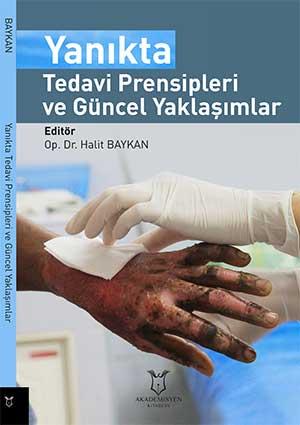
Yanık Rehabilitasyonu
Özet
Yanık rehabilitasyonu, hastanın hastaneye kabulüyle başlayan ve multidisipliner bir ekip çalışması gerektiren uzun vadeli, zahmetli bir tedavi sürecidir. Plastik cerrah, fiziyatrist, fizyoterapist, iş-uğraşı terapisti ve psikolog gibi uzmanlardan oluşan bu ekibin temel amacı; eklem hareket kısıtlılıklarını önlemek, fonksiyonel ve estetik sekelleri en aza indirmek, kas atrofisini engellemek ve hastayı hızla günlük yaşamına döndürmektir. Tedavi süreci kabaca akut ve akut sonrası dönem olarak ikiye ayrılır. Akut dönemde ödemi ve kontraktürleri önlemek amacıyla anti-kontraktür pozisyonlaması, splintleme ve erken evre eklem hareket açıklığı (EHA) egzersizleri kritik önem taşır. Ciltte oluşan skar dokusunun kontraktürlere yol açmasını engellemek için germe egzersizleri nazikçe başlatılmalı ve hastanın toleransı arttıkça yoğunlaştırılmalıdır. Greft uygulanan hastalarda egzersiz plastik cerrah kontrolünde 7-10 gün sonra başlarken, alt ekstremitede greft yoksa komplikasyonları önlemek için erken ambulasyon teşvik edilir. Akut sonrası dönemde ise kazanılan hareket açıklığını korumak adına statik ve dinamik splintlerden yararlanılır, parafin ve ultrason gibi fizik tedavi modaliteleriyle süreç desteklenir. İyileşmesi yaklaşık iki yıl süren skar dokusu nedeniyle egzersizlere uzun süre devam edilmeli, heterotopik ossifikasyon ve periferik sinir yaralanmaları gibi komplikasyonlar yakından takip edilmelidir.
Burn rehabilitation is a long-term, arduous treatment process that begins with the patient's hospital admission and requires a multidisciplinary team effort. The primary goal of this team, which consists of specialists such as plastic surgeons, physiatrists, physiotherapists, occupational therapists, and psychologists, is to prevent joint movement restrictions, minimize functional and aesthetic sequelae, prevent muscle atrophy, and quickly return the patient to daily life. The treatment process is roughly divided into acute and post-acute periods. In the acute period, anti-contracture positioning, splinting, and early-stage range of motion (ROM) exercises are of critical importance to prevent edema and contractures. To prevent the scar tissue formed on the skin from causing contractures, stretching exercises should be started gently and intensified as the patient's tolerance increases. In patients undergoing grafting, exercise starts 7-10 days later under the control of a plastic surgeon, whereas early ambulation is encouraged to prevent complications if there is no lower extremity graft. In the post-acute period, static and dynamic splints are utilized to maintain the gained range of motion, and the process is supported by physical therapy modalities such as paraffin and ultrasound. Due to the scar tissue taking approximately two years to mature, exercises should be continued for a long time, and complications like heterotopic ossification and peripheral nerve injuries must be closely monitored.
Referanslar
Yapıcı AK, Durmuş M, Ata E, Durusu M, Tekin L. Burn Rehabilitation. Turk J Plast Surg. 2016;24(4):173–8.
Aydemir K TMA. Yanik Rehabilitasyonu. J Turk Soc Intens Care. 2011;9:70–7.
Procter F. Rehabilitation of the burn patient. Indian J Plast Surg Off Publ Assoc Plast Surg India. 2010;43(Suppl):S101.
DeLisa, Joel A., and Bruce M. Gans. Çeviren: Hatice U. AS. Yanık Rehabilitasyonu. In: Joel . Delisa ÇETA, editor. Fiziksel tıp ve rehabilitasyon: ilkeler ve uygulamalar. 4th ed. Ankara: Güneş Tıp Kitabevleri; 2007. p. 1867–89.
Beyazova, Mehmet, and Yeşim Gökçe Kutsal E. Yanık rehabilitasyonu. In: Mehmet B. YGK, editor. Fiziksel tıp ve rehabilitasyon. 2nd ed. Ankara: Güneş Tıp Kitabevleri; 2011. p. 1583–91.
Helm PA, Pandian G, Heck E. Neuromuscular problems in the burn patient: cause and prevention. Arch Phys Med Rehabil. 1985;66(7):451–3.
Esselman PC MM. Yanık rehabilitasyonunda konular. In: Braddom RL (ed) Fiziksel Tıp ve Rehabilitasyon. Ankara: Güneş Tıp Kitabevleri; 2010. p. 1399–413.
Serghiou M, Cowan A, Whitehead C. Rehabilitation after a burn injury. Clin Plast Surg. 2009;36(4):675–86.
Sprouse RA, McLaughlin AM, Harris GD. Braces and splints for common musculoskeletal conditions. Am Fam Physician. 2018;98(10):570–6.
Hundeshagen G, Suman OE, Branski LK. Rehabilitation in the acute versus outpatient setting. Clin Plast Surg. 2017;44(4):729–35.
Spires MC, Kelly BM, Pangilinan Jr PH. Rehabilitation methods for the burn injured individual. Phys Med Rehabil Clin N Am. 2007;18(4):925–48.
Dewey WS, Richard RL, Parry IS. Positioning, splinting, and contracture management. Phys Med Rehabil Clin. 2011;22(2):229–47.
Richard R, Baryza MJ, Carr JA, Dewey WS, Dougherty ME, Forbes-Duchart L, et al. Burn rehabilitation and research: proceedings of a consensus summit. J Burn Care Res. 2009;30(4):543–73.
Richard R, Ward RS. Splinting strategies and controversies. J Burn Care Rehabil. 2005;26(5):392–6.
Schneider JC, Qu HD. Neurologic and musculoskeletal complications of burn injuries. Phys Med Rehabil Clin. 2011;22(2):261–75.
Wright PC. Fundamentals of acute burn care and physical therapy management. Phys Ther. 1984;64(8):1217–31.
Smith TO. When should patients begin ambulating following lower limb split skin graft surgery? A systematic review. Physiotherapy. 2006;92(3):135–45.
Serghiou MA, Ott S, Whitehead C, Cowan A, McEntire S, Suman OE. Comprehensive rehabilitation of the burn patient. In: Total Burn Care: Fourth Edition. Elsevier Inc.; 2012. p. 517–49.
Tilley W, McMahon S, Shukalak B. Rehabilitation of the burned upper extremity. Hand Clin. 2000;16(2):303–18.
Hettrick H, O’Brien K, Laznick H, Sanchez J, Gorga D, Nagler W, et al. Effect of transcutaneous electrical nerve stimulation for the management of burn pruritus: a pilot study. J Burn Care Rehabil. 2004;25(3):236–40.
Elledge ES, Smith AA, McMANUS WF, Pruitt Jr BA. Heterotopic bone formation in burned patients. J Trauma. 1988;28(5):684–7.
Levine NS, Atkins A, McKEEL Jr DW, Peck SD, PRUITT Jr BA. Spinal cord injury following electrical accidents. J Trauma Acute Care Surg. 1975;15(5):459–63.
Crawford CM, Varghese G, Mani MM, Neff JR. Heterotopic ossification: are range of motion exercises contraindicated? J Burn Care Rehabil. 1986;7(4):323–7.