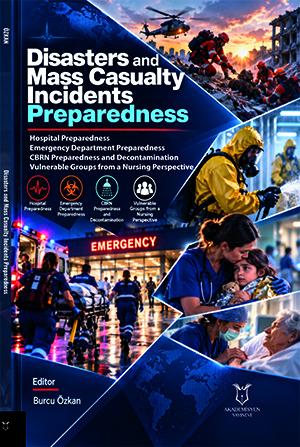
Disasters and Mass Casualty Incidents Preparedness
Synopsis
-
References
United Nations Office for Disaster Risk Reduction. Monitoring the Sendai Framework. (Accessed August 20, 2026, from https://www.undrr.org/implementing-sendai-framework/monitoring-sendai-framework).
Işık Ö, Aydınlıoğlu HM, Koç S, et al. Disaster management and disaster-oriented health services. Journal of Okmeydanı Training and Research Hospital. 2012;28(Suppl 2): 82–123. doi:10.5222/otd.supp2.2012.082
Markenson D, Losinski S. Hospital and emergency department preparedness. In: Veenema TG (ed.) Disaster nursing and emergency preparedness for chemical, biological, and radiological terrorism and other hazards. 4th ed. New York: Springer Publishing Company; 2019. p. 51–66.
Farah B, Pavlova M, Groot W. Hospital disaster preparedness in sub-Saharan Africa: a systematic review of English literature. BMC Emergency Medicine. 2023;23: 71. doi:10.1186/s12873-023-00843-5
Çınar Ö, Yıldız E. Level of preparedness for disasters and emergencies in hospitals: the effect of planning, drill, and unit effectiveness levels. International Journal of Economic and Administrative Studies. 2024;43: 125–140. doi:10.18092/ulikidince.1424720
Ali HM, Desha C, Ranse J, et al. Planning and assessment approaches towards disaster resilient hospitals: a systematic literature review. International Journal of Disaster Risk Reduction. 2021;61: 102319. doi:10.1016/j.ijdrr.2021.102319
Pan American Health Organization. Resilient hospitals: an inter-regional guidance on strengthening resilience to health emergencies and disasters in health facilities. Washington: PAHO; 2024. doi:10.37774/9789275129067
İkizceli İ, Akdeniz YS. Emergency services in disasters from the hospital perspective. SD Journal. 2017;42: 40–43.
Şahin Ş, Üçgül İ. Disaster management and occupational health and safety in Türkiye. Journal of Disasters and Risk. 2019;2(1): 43–63. doi:10.35341/afet.498594
Şahin N. Disaster management and emergency aid plans. In: TMMOB İzmir City Symposium; January 8–10, 2009; İzmir. TMMOB Chamber of City Planners. p. 131–142.
Samei B, Babaie J, Tabrizi JS, et al. Exploring hospitals’ functional preparedness effective factors in response to disasters: a qualitative study in a lower middle-income country. BMC Health Services Research. 2024;24: 197. doi:10.1186/s12913-024-10630-y
Getu SB, Walle Tsegaw F, Arcos González P, et al. Hospital disasters preparedness for mass-casualty incidents at emergency units in Northwest of Ethiopia: a cross-sectional study. Prehospital and Disaster Medicine. 2023;38(3): 360–365. doi:10.1017/S1049023X23000365
Ugelvik KS, Thomassen Ø, Braut GS, et al. A national study of in-hospital preparedness for mass casualty incidents and disasters. European Journal of Trauma and Emergency Surgery. 2025;51(1): 18. doi:10.1007/s00068-024-02685-7
Ministry of Health. Hospital disaster and emergency plan (HDEP) preparation guideline. 2nd ed. Ankara: Republic of Türkiye Ministry of Health, General Directorate of Emergency Health Services; 2021.
Çiçekdağı Hİ, Bozkurt Ö. Hospital Disaster and Emergency Plan (HDEP): a comparative analysis of the 2015 and 2021 preparation guidelines. Journal of Ankara Health Sciences. 2022;11(2): 241–251. doi:10.46971/ausbid.1205124
Regulation on Disaster and Emergency Response Services. Official Gazette. December 18, 2013; No. 28855.
Lynn M. Hospital planning and response to sudden mass casualty incidents. In: Lynn M (ed.) Disaster and mass casualty incidents. Cham: Springer Nature; 2019. p. 29–42.
Nakhle R, Abou Khater D, Mouawad YA, et al. Hospital emergency preparedness plan review in a low-resource country after a mass casualty incident: the Beirut blast. Cureus. 2024;16(10): e71410. doi:10.7759/cureus.71410
Hasan MK, Nasrullah SM, Quattrocchi A, et al. Hospital surge capacity preparedness in disasters and emergencies: a systematic review. Public Health. 2023;225: 12–21. doi:10.1016/j.puhe.2023.09.017
Petanidis S, Chandramouli K, Floros G, et al. Optimizing emergency response in hospitals: a systematic review of surge capacity planning and crisis resource management. Healthcare. 2025;13(21): 2819. doi:10.3390/healthcare13212819
Armstrong JBP. Preparing your emergency department for disaster: optimizing surge capacity during mass casualty events. Healthcare Management Forum. 2024;37(2): 86–89. doi:10.1177/08404704231199403
Hendrickson R, Horowitz BZ. Disaster preparedness and response. In: Tintinalli JE (ed.) Tintinalli’s emergency medicine: a comprehensive study guide. İstanbul: Nobel Tıp Kitabevleri; 2013. p. 29–30.
Usta G, Torpuş K, Küçük U. The START triage scale in disasters. Journal of Natural Disasters and the Environment. 2017;3(2): 70–76. doi:10.21324/dacd.320067
McMahon MM. Hospital impact: emergency department. In: Powers R, Daily E (eds.) International disaster nursing. Cambridge: Cambridge University Press; 2010. p. 81–100. doi:10.1017/CBO9780511841415.009
Yüksel S. Hospital and emergency unit preparedness in disasters. In: Öztekin SD (ed.) Disaster nursing. Ankara: Türkiye Clinics; 2018. p. 16–22.
Shafiei A, Arsalani N, Beyrami Jam M, et al. The impact of surge capacity enhancement training for nursing managers on hospital disaster preparedness and response: an action research study. BMC Emergency Medicine. 2024;24(1): 153. doi:10.1186/s12873-024-00930-1
Samei B, Babaie J, Tabrizi JS, et al. Factors affecting the functional preparedness of hospitals in response to disasters: a systematic review. Bulletin of Emergency & Trauma. 2023;11(3): 109–118. doi:10.30476/BEAT.2023.97841.1414
Regulation on the Implementation of Hospital Disaster and Emergency Plans (HDEP). Official Gazette. March 18, 2020; No. 31072.
Karcıoğlu Ö, Topaçoğlu H. Emergency department triage in war and terror disasters. The Medical Journal of Okmeydanı Training and Research Hospital. 2017;33(Suppl): 1–8. doi:10.5222/otd.2017.001
Açıksarı K. Scene management and central management in disasters. Türkiye Clinics: Emergency Medicine – Special Topics. 2019;5(1): 40–48.
Kemaloğlu M. The history and legal development of disaster management in Türkiye. Akademik Bakış Journal. 2015;52: 126–147.
Işık Ö, Aydınlıoğlu HM, Koç S, et al. Disaster management and disaster-oriented health services. The Medical Journal of Okmeydanı Training and Research Hospital. 2012;28(Suppl 2): 82–123. doi:10.5222/otd.supp2.2012.082
Markenson D, Losinski S. Hospital and emergency department preparedness. In: Veenema TG (ed.) Disaster nursing and emergency preparedness for chemical, biological, and radiological terrorism and other hazards. 4th ed. New York: Springer Publishing Company; 2019. p. 51–66.
Çakın Ö, Yüce Aktepe M, Acar S, et al. Kahramanmaraş-Pazarcık earthquake 2023: characteristics of patients presented to the emergency department of a tertiary hospital far from the region and infection characteristics in hospitalized patients. Prehospital and Disaster Medicine. 2024;39(1): 25–31. doi:10.1017/S1049023X24000062
Ugelvik KS, Thomassen Ø, Braut GS, et al. A national study of in-hospital preparedness for mass casualty incidents and disasters. European Journal of Trauma and Emergency Surgery. 2025;51(1): 18. doi:10.1007/s00068-024-02685-7
Suda AJ, Franke A, Hertwig M, et al. Management of mass casualty incidents: a systematic review and clinical practice guideline update. European Journal of Trauma and Emergency Surgery. 2025;51(1): 5. doi:10.1007/s00068-024-02727-0
Aldossari FM, Al Bensaad HS. The evolving role of the emergency department in mass casualty incident (MCI) response: a review of triage, surge capacity, and decontamination strategies. Asian Journal of Medicine and Health. 2025;23(10): 27–40. (Accessed September 15, 2026, from https://hal.science/hal-05309255).
Faul M, Sasser SM, Lairet J, et al. Trauma center staffing, infrastructure, and patient characteristics that influence trauma center need. Western Journal of Emergency Medicine. 2015;16(1): 98–106. doi:10.5811/westjem.2014.10.22837
Bucher L. Emergency, terrorism, and disaster nursing. In: Lewis SL, Dirksen SR, Heitkemper MM, et al. (eds.) Medical-surgical nursing: assessment and management of clinical problems. 8th ed. St. Louis: Mosby; 2011.
McMahon MM. Hospital impact: emergency department. In: Powers R, Daily E (eds.) International disaster nursing. Cambridge: Cambridge University Press; 2010. p. 81–100. doi:10.1017/CBO9780511841415.009
Slepski LA. Emergency preparedness: concept development for nursing practice. Nursing Clinics of North America. 2005;40(3): 419–430.
Karcıoğlu Ö, Topaçoğlu H. Emergency department triage in war and terror disasters. The Medical Journal of Okmeydanı Training and Research Hospital. 2017;33(Suppl): 1–8. doi:10.5222/otd.2017.001
Nakhle R, Abou Khater D, Mouawad YA, et al. Hospital emergency preparedness plan review in a low-resource country after a mass casualty incident: the Beirut blast. Cureus. 2024;16(10): e71410. doi:10.7759/cureus.71410
Bloch YH, Leiba A, Veaacnin N, et al. Managing mild casualties in mass-casualty incidents: lessons learned from an aborted terrorist attack. Prehospital and Disaster Medicine. 2007;22(3): 181–185. doi:10.1017/S1049023X00004623
Açıksarı K. Scene management and central management in disasters. Türkiye Clinics: Emergency Medicine – Special Topics. 2019;5(1): 40–48.
Usta G, Torpuş K, Küçük U. The START triage scale in disasters. Journal of Natural Disasters and the Environment. 2017;3(2): 70–76. doi:10.21324/dacd.320067
Koop D, Ward M. Major incident preparedness management. In: Curtis K, Ramsden C (eds.) Emergency and trauma care for nurses and paramedics. Chatswood: Mosby Australia; 2011. p. 185–220.
Frykberg ER. Medical management of disasters and mass casualties from terrorist bombings: how can we cope? The Journal of Trauma. 2002;53(2): 201–212. doi:10.1097/00005373-200208000-00001
Bazyar J, Farrokhi M, Salari A, et al. Accuracy of triage systems in disasters and mass casualty incidents: a systematic review. Archives of Academic Emergency Medicine. 2022;10(1): e32. doi:10.22037/aaem.v10i1.1526
Lerner EB, Schwartz RB, Coule PL, et al. Mass casualty triage: an evaluation of the data and development of a proposed national guideline. Disaster Medicine and Public Health Preparedness. 2008;2(Suppl. 1): 25–34. doi:10.1097/DMP.0b013e318182194e
Lerner EB, Cone DC, Weinstein ES, et al. Mass casualty triage: an evaluation of the science and refinement of a national guideline. Disaster Medicine and Public Health Preparedness. 2011;5(2): 129–137. doi:10.1001/dmp.2011.39
Kahn CA, Lerner EB, Cone DC. Triage. In: Koenig KL, Schultz CH (eds.) Koenig and Schultz’s disaster medicine: comprehensive principles and practices. 2nd ed. Cambridge: Cambridge University Press; 2016. p. 208–218. doi:10.1017/CBO9781139629317.017
Romig LE. Pediatric triage. A system to JumpSTART your triage of young patients at MCIs. JEMS: a journal of emergency medical services. 2002;27(7): 52–58. PMID: 12141119
Usoro A, Mehmood A, Rapaport S, et al. A scoping review of the essential components of emergency medical response systems for mass casualty incidents. Disaster Medicine and Public Health Preparedness. 2023;17: e274. doi:10.1017/dmp.2022.235
Singh P, Sapkota S, Achour N, et al. Learning from the past: a scoping review of hospital disaster preparedness assessment. BMC Emergency Medicine. 2026;26(1): 43. doi:10.1186/s12873-026-01474-2
Maimone S, Creary K, Miele J, et al. Crisis-optimized patient tracking: a novel approach for mass casualty incident management in emergency departments. Disaster Medicine and Public Health Preparedness. 2026;20: e97. doi:10.1017/dmp.2026.10360
Özkan B, Çetinkaya Kutun F. Disaster psychology. Health Care Academician Journal. 2021;8(3): 249–256. doi:10.52880/sagakaderg.868877
Özkan B. Mass casualties and disaster psychology. In: Uyar Hazar H (ed.) Health & Science 2025: Nursing-III. İstanbul: Efe Akademi Publications; 2025. p. 87–106. doi:10.59617/efepub2025169
Anesi GL. Hospital transfers across US regions to address the “space” shortage in a pandemic: a public good. Clinical Infectious Diseases. 2021;73(11): e4111–e4112. doi:10.1093/cid/ciaa1596
Gerdan S, Yazıcı A, Yılmaz S, et al. Sustainability of health services in a university hospital during disaster: the Kahramanmaraş earthquakes experience. Bezmialem Science. 2025;13(4): 334–341. doi:10.14235/bas.galenos.2025.25993
Sarzynski SH, Mancera AG, Yek C, et al. Trends in patient transfers from overall and caseload-strained US hospitals during the COVID-19 pandemic. JAMA Network Open. 2024;7(2): e2356174. doi:10.1001/jamanetworkopen.2023.56174
Tayfur I, Kako M, Gündüz A, et al. Exploring key capacities: insights from assessing the resilience of the public health system before and after the Kahramanmaraş earthquakes. International Journal of Disaster Risk Science. 2024;15(5): 688–702. doi:10.1007/s13753-024-00588-0
Hasan MK, Nasrullah SM, Quattrocchi A, et al. Hospital surge capacity preparedness in disasters and emergencies: a systematic review. Public Health. 2023;225: 12–21. doi:10.1016/j.puhe.2023.09.017
Petanidis S, Chandramouli K, Floros G, et al. Optimizing emergency response in hospitals: a systematic review of surge capacity planning and crisis resource management. Healthcare. 2025;13(21): 2819. doi:10.3390/healthcare13212819
Semerci M, Şahinöz S. Disaster preparedness of public hospitals. Urban Academy. 2024;17(1): 294–307. doi:10.35674/kent.1399123
Seyghalani Talab F, Ahadinezhad B, Khosravizadeh O, et al. A model of the organizational resilience of hospitals in emergencies and disasters. BMC Emergency Medicine. 2024;24(1): 105. doi:10.1186/s12873-024-01026-6
Pan American Health Organization. Resilient hospitals: an inter-regional guidance on strengthening resilience to health emergencies and disasters in health facilities. Washington: PAHO; 2024. doi:10.37774/9789275129067
Shafiei A, Arsalani N, Beyrami Jam M, et al. The impact of surge capacity enhancement training for nursing managers on hospital disaster preparedness and response: an action research study. BMC Emergency Medicine. 2024;24(1): 153. doi:10.1186/s12873-024-00930-1
Presidency of the Republic of Türkiye, Presidency of Strategy and Budget. 2023 Kahramanmaraş and Hatay earthquakes report. Ankara; 2023. (Accessed September 15, 2026, from https://www.sbb.gov.tr/2023-kahramanmaras-ve-hatay-depremleri-raporu/).
Yarkaç A, Buyurgan ÇS, Bozkurt Babuş S, et al. Mersin University Medical Faculty Hospital Emergency Department and triage organization after the 2023 Kahramanmaraş earthquake. Global Emergency and Critical Care. 2023;2(3): 109–116. doi:10.4274/globecc.galenos.2023.35220
Köroğlu M, Karakaplan M, Ergen E, et al. The initial response of a local hospital in the earthquake zone during the February 6, 2023 Kahramanmaraş earthquakes: injuries and challenges. Acta Orthopaedica et Traumatologica Turcica. 2023;57(6): 315–321. doi:10.5152/j.aott.2023.23138
Sarı H, Özel M, Akkoç MF, et al. First-week analysis after the Turkey earthquakes: demographic and clinical outcomes of victims. Prehospital and Disaster Medicine. 2023;38(3): 294–300. doi:10.1017/S1049023X23000493
Atmis B, Bayazit AK, Cagli Piskin C, et al. Factors predicting kidney replacement therapy in pediatric earthquake victims with crush syndrome in the first week following rescue. European Journal of Pediatrics. 2023;182(12): 5591–5598. doi:10.1007/s00431-023-05250-3
Buyurgan ÇS, Bozkurt Babuş S, Yarkaç A, et al. Demographic and clinical characteristics of earthquake victims presented to the emergency department with and without crush injury upon the 2023 Kahramanmaraş (Turkey) earthquake. Prehospital and Disaster Medicine. 2023;38(6): 707–715. doi:10.1017/S1049023X23006416
Sofuoğlu Z, Başer A, Sofuoğlu T, et al. First responders’ experiences with major earthquakes in Türkiye: a qualitative study of innovation needs and challenges. BMC Emergency Medicine. 2025;25(1): 60. doi:10.1186/s12873-025-01217-9
Tahernejad A, Sahebi A, Salehi Sahl Abadi A, et al. Application of artificial intelligence in triage in emergencies and disasters: a systematic review. BMC Public Health. 2024;24(1): 3203. doi:10.1186/s12889-024-20447-3
Goulart De Medeiros M, Lequarre A, Geypens B, et al. EU CBRNe glossary. Luxembourg: Publications Office of the European Union; 2022. JRC128863. doi:10.2760/0
Health Canada. Chemical, biological, radiological, nuclear and explosive (CBRNE) events. Ottawa: Government of Canada; 2021. (Accessed September 18, 2026, from https://www.canada.ca/en/health-canada/services/health-concerns/emergencies-disasters/chemical-biological-radiological-nuclear-explosive-events.html).
Disaster and Emergency Management Presidency (AFAD). CBRN glossary of terms. Ankara: Republic of Türkiye Ministry of Interior; 2021. (Accessed September 18, 2026, from https://www.afad.gov.tr/kurumlar/afad.gov.tr/e_Kutuphane/Kitaplar/KBRN-Terimler-Sozlugu-2021.pdf).
Qzih ES, Ahmad MM. Hospital-based preparedness measures for CBRNE disasters: a systematic review. Environmental Health Insights. 2024;18. doi:10.1177/11786302241288859
Ranse J, Mackie B, Crilly J, et al. Strengthening emergency department response to chemical, biological, radiological, and nuclear disasters: a scoping review. Australasian Emergency Care. 2025;28(1): 37–47. doi:10.1016/j.auec.2024.09.003
Razak S, Hignett S, Barnes J. Emergency department response to chemical, biological, radiological, nuclear, and explosive events: a systematic review. Prehospital and Disaster Medicine. 2018;33(5): 543–549. doi:10.1017/S1049023X18000900
Daniels R, Nicoll L. Mass casualty care. In: Contemporary medical-surgical nursing. 2nd ed. Clifton Park (NY): Delmar Cengage Learning; 2012. p. 1885.
McMahon MM. Hospital impact: emergency department. In: Powers R, Daily E (eds.) International disaster nursing. Cambridge: Cambridge University Press; 2010. p. 81–100. doi:10.1017/CBO9780511841415.009
Markenson D, Losinski S. Hospital and emergency department preparedness. In: Veenema TG (ed.) Disaster nursing and emergency preparedness for chemical, biological, and radiological terrorism and other hazards. 4th ed. New York: Springer Publishing Company; 2019. p. 51–66.
Regulation on Duties Regarding Chemical, Biological, Radiological and Nuclear Threats and Hazards. Official Gazette; October 1, 2020, No. 31261.
Chilcott RP. Managing mass casualties and decontamination. Environment International. 2014;72: 37–45. doi:10.1016/j.envint.2014.02.006
Republic of Türkiye Ministry of Health, General Directorate of Emergency Health Services. Directive on the duties of the Ministry of Health and its affiliated institutions regarding chemical, biological, radiological and nuclear hazards. Ankara: Republic of Türkiye Ministry of Health; 2014.
Regulation on Disaster and Emergency Response Services. Official Gazette; February 24, 2022, No. 31760.
Johnston GM, Wills BK. Chemical decontamination. Treasure Island (FL): StatPearls Publishing; 2023. (Accessed September 18, 2026, from https://www.ncbi.nlm.nih.gov/books/NBK538161/).
Institute of Medicine (US) Committee on R&D Needs for Improving Civilian Medical Response to Chemical and Biological Terrorism Incidents. Personal protective equipment. In: Chemical and biological terrorism: research and development to improve civilian medical response. Washington (DC): National Academies Press; 1999. (Accessed September 18, 2026, from https://www.ncbi.nlm.nih.gov/books/NBK230676/).
Zhang HL, Yang S, Luo HX, et al. The error-prone operational steps and key sites of self-contamination during donning and doffing of personal protective equipment by health care workers. Disaster Medicine and Public Health Preparedness. 2022;16(6): 2486–2491. doi:10.1017/dmp.2021.142
Malek A, Hertelendy AJ, Alshaikh E, et al. Effectiveness of chemical, biological, radiological, nuclear, explosive (CBRNE) event-response training in a hospital setting: a scoping review. Disaster Medicine and Public Health Preparedness. 2025;20: e2. doi:10.1017/dmp.2025.10274
Héon D, Foltin GL. Principles of pediatric decontamination. Clinical Pediatric Emergency Medicine. 2009;10(3): 186–194. doi:10.1016/j.cpem.2009.06.006
Chilcott RP, Larner J, Matar H. UK’s initial operational response and specialist operational response to CBRN and HazMat incidents: a primer on decontamination protocols for healthcare professionals. Emergency Medicine Journal. 2019;36(2): 117–123. doi:10.1136/emermed-2018-207562
Alshaikh E, Hertelendy AJ, Issa F, et al. Evaluating the effectiveness of dry decontamination methods for hazmat incidents: a scoping review. Disaster Medicine and Public Health Preparedness. 2025;19: e160. doi:10.1017/dmp.2025.10058
Karcıoğlu Ö, Topaçoğlu H. Emergency department triage in war and terror disasters. The Medical Journal of Okmeydanı Training and Research Hospital. 2017;33(Suppl): 1–8. doi:10.5222/otd.2017.001
Chilcott RP, Mitchell H, Matar H. Optimization of nonambulant mass casualty decontamination protocols as part of an initial or specialist operational response to chemical incidents. Prehospital Emergency Care. 2019;23(1): 32–43. doi:10.1080/10903127.2018.1469705
Amlôt R, Carter H, Riddle L, et al. Volunteer trials of a novel improvised dry decontamination protocol for use during mass casualty incidents as part of the UK’s Initial Operational Response (IOR). PLOS ONE. 2017;12(6): e0179309. doi:10.1371/journal.pone.0179309
Kassouf N, Syed S, Larner J, et al. Evaluation of absorbent materials for use as ad hoc dry decontaminants during mass casualty incidents as part of the UK’s Initial Operational Response (IOR). PLOS ONE. 2017;12(2): e0170966. doi:10.1371/journal.pone.0170966
Aldossari FM, Al Bensaad HS. The evolving role of the emergency department in mass casualty incident (MCI) response: a review of triage, surge capacity, and decontamination strategies. Asian Journal of Medicine and Health. 2025;23(10): 27–40. (Accessed September 15, 2026, from https://hal.science/hal-05309255).
Newgard CD, Lin A, Malveau S, et al. Emergency department pediatric readiness and short-term and long-term mortality among children receiving emergency care. JAMA Network Open. 2023;6(1): e2250941. doi:10.1001/jamanetworkopen.2022.50941
Alshaikh E, Issa F, Hertelendy AJ, et al. Pediatric decontamination considerations in CBRN events: a scoping review. Disaster Medicine and Public Health Preparedness. 2025;19: e333. doi:10.1017/dmp.2025.10260
Hignett S, Hancox G, Otter ME. Chemical, biological, radiological, nuclear and explosive (CBRNe) events: systematic literature review of evacuation, triage and decontamination for vulnerable people. International Journal of Emergency Services. 2019;8(2): 175–190. doi:10.1108/IJES-05-2018-0030
Carter H, Drury J, Amlôt R, et al. Effective responder communication improves efficiency and psychological outcomes in a mass decontamination field experiment: implications for public behaviour in the event of a chemical incident. PLOS ONE. 2014;9(3): e89846. doi:10.1371/journal.pone.0089846
Kippnich M, Schorscher N, Sattler H, et al. Managing CBRN mass casualty incidents at hospitals—find a simple solution for a complex problem: a pilot study. American Journal of Disaster Medicine. 2024;19(1): 25–31. doi:10.5055/ajdm.0471
Lee J, Henne JE, Welsh J. Emergency preparedness in perioperative services [Safety First]. AORN Journal. 2024;120(4): 251–257. doi:10.1002/aorn.14221
İpekçi NN. Health of vulnerable groups in disasters. Journal of Health Sciences and Clinical Research. 2023;2(3): 147–156. doi:10.5281/zenodo.10445745
Arı Kovancı Y. Disasters and vulnerable groups. The Journal of Siirt University Institute of Social Sciences. 2024;12(1): 13–30. doi:10.53586/susbid.1474653
Needs Map. (2025). Lessons learned from the Kahramanmaraş earthquakes response process: Vulnerable groups thematic analysis report. Needs Map.
Sözer H. Identification of vulnerable groups among Kahramanmaraş earthquake survivors and the development of policies on safety, security, and trust. In: Öztürk M, Kırca M (eds.) Academic recommendations for the aftermath of the Kahramanmaraş-centered earthquakes. Gaziantep: Özgür Publications; 2023. p. 411–424.
Altıok B, Arıcı A, Özüçelik DN. Effects of the February 6, 2023 Kahramanmaraş earthquakes on women and children and social work interventions. Socrates Journal of Interdisciplinary Social Researches. 2025;11(52): 1–28. doi:10.5281/zenodo.15244885
Wisner B, Blaikie P, Cannon T, et al. At risk: natural hazards, people’s vulnerability and disasters. 2nd ed. London: Routledge; 2004.
Cutter SL, Boruff BJ, Shirley WL. Social vulnerability to environmental hazards. Social Science Quarterly. 2003;84(2): 242–261. doi:10.1111/1540-6237.8402002
Yılmaz S. Disasters and vulnerable groups. Emergency Medicine Association of Turkey, Disaster Commission, Disaster Article Series; 2024. (Accessed September 16, 2026, from https://tatd.org.tr/afet/afet-yazi-dizisi/afetler-ve-kirilgan-gruplar/).
Doust Mohammadi MM, Salmani I, Farahmandnia H. Social vulnerabilities among immigrants and refugees in emergencies and disasters: a systematic review. Frontiers in Public Health. 2024;11: 1235464. doi:10.3389/fpubh.2023.1235464
Aral N. Effects of earthquakes on children. Journal of Child and Development. 2023;6(11): 93–105. doi:10.36731/cg.1299175
Özkan B, Çetinkaya Kutun F. Disaster psychology. Health Care Academician Journal. 2021;8(3): 249–256. doi:10.52880/sagakaderg.868877
Açık B, Demir M, Adalı S, et al. Psychological interventions for post-traumatic stress disorder developing after earthquakes in Türkiye: a systematic review. Journal of Disaster and Risk. 2025;8(2): 468–486. doi:10.35341/afet.1422407
Bayraktar N, Dal Yılmaz Ü. Vulnerability of elderly people in disasters: a systematic review. Turkish Journal of Geriatrics. 2018;21(3): 467–482. doi:10.31086/tjgeri.2018344062
Türk A. A disability-sensitive disaster management model specific to earthquakes. Journal of Disaster and Risk. 2022;5(1): 61–77. doi:10.35341/afet.1078869
Küçükkaya B, Özoğlu M. The effect of earthquakes experienced during pregnancy on maternal health and birth outcomes: a review. The Journal of Social Health. 2025;5(1): 1–14. doi:10.69514/sosyalsaglik.1476363
Gümüş D, Yılmaz Z, Tuncer M, et al. The role of nurses in disaster management. Journal of Disaster and Risk. 2024;7(2): 354–367. doi:10.35341/afet.1329817
Arıca F, Çakır C, Kağnıcı DY. Psychosocial services in disasters with a focus on vulnerable groups. Journal of Disaster and Risk. 2023;6(1): 176–187. doi:10.35341/afet.1173165
Al Thobaity A. Overcoming challenges in nursing disaster preparedness and response: an umbrella review. BMC Nursing. 2024;23: 562. doi:10.1186/s12912-024-02226-y
Downloads
Published
License
LicenseBu İnternet Sitesi içeriğinde yer alan tüm eserler (yazı, resim, görüntü, fotoğraf, video, müzik vb.) Akademisyen Kitabevine ait olup, 5846 sayılı Fikir ve Sanat Eserleri Kanunu ve 5237 sayılı Türk Ceca Kanunu kapsamında korunmaktadır. Bu hakları ihlal eden kişiler, 5846 sayılı Fikir ve Sanat eserleri Kanunu ve 5237 sayılı Türk Ceza Kanununda yer alan hukuki ve cezai yaptırımlara tabi olurlar. Yayınevi ilgili yasal yollara başvurma hakkına sahiptir.
